

When designing a municipal solid waste (MSW) recycling line, choosing between a bag opener and a primary shredder can directly affect material handling, sorting efficiency, and downstream processing. Although both machines are used in waste pretreatment, they serve different purposes.
A bag opener primarily opens bags containing mixed waste and releases the materials inside. A MSW primary shredder, by contrast, focuses on reducing the size of mixed, bulky, or irregular waste to make it easier to transport, sort, or process further.
The right choice depends on the composition of the incoming waste, the proportion of bagged materials, the required output size, and the final application. In some projects, one machine is sufficient. In others, combining both can create a more effective pretreatment system.
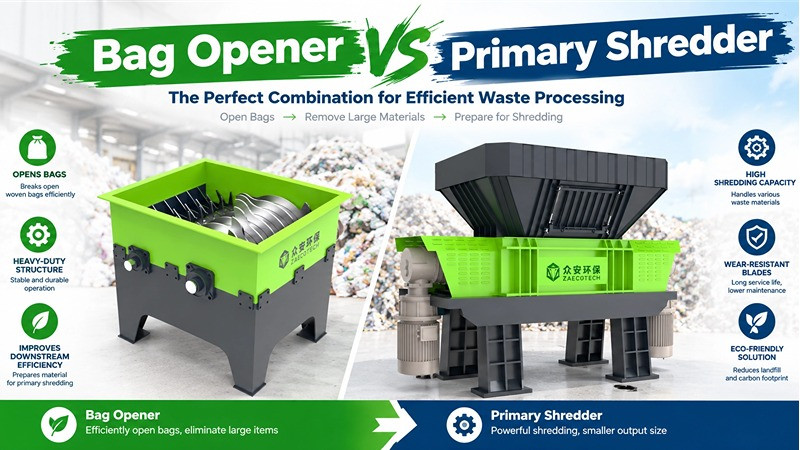
A waste bag opener is designed to break open plastic bags and other packaging containing household or commercial waste. Once the bags are opened, their contents can spread out and move more freely through downstream screening and sorting equipment.
For example, household waste bags may contain food scraps, plastic bottles, paper, textiles, metal packaging, and other recyclable or combustible materials. If these items remain enclosed in bags, screening and sorting equipment may have difficulty separating them effectively.
A bag opener helps make these materials accessible for subsequent processing.
A typical bag opener uses rotating shafts and cutting or tearing elements to open waste bags. Depending on the machine design and operating conditions, some size reduction may also occur.
The general process is:
Bagged waste enters the feeding system.
The bag opener tears open the bags.
The contents are released into the material stream.
Conveyors transport the opened waste to screening or sorting equipment.
Subsequent equipment separates recyclables, organic fractions, combustible materials, and residual waste as required.
This process helps prepare mixed waste for more consistent downstream handling.

Improved access to waste contents: Opening bags exposes materials that would otherwise remain enclosed, helping downstream screens and sorting equipment work more effectively.
Better preparation for material recovery: Once the contents are released, recyclable materials such as plastics, metals, and paper may be easier to identify and separate, depending on the sorting configuration.
Support for screening and sorting: A bag opener can be installed before a trommel screen, magnetic separator, manual sorting station, or other separation equipment.
Compact pretreatment configuration: Bag openers can provide a dedicated bag-opening stage without requiring every incoming material to undergo intensive primary shredding.
Reference specifications for ZAECOTECH bag opener:
| Model | Reference Capacity | Installed Power |
|---|---|---|
| PD100 | 12–20 m³/h | 26 kW |
| PD130 | 25–40 m³/h | 42.5 kW |
| PD160 | 40–60 m³/h | 62.5 kW |
These figures are equipment reference values, not guaranteed throughput for every waste stream. Actual performance depends on bag material, bag density, waste composition, feeding conditions, and operating settings.
The published capacity is measured in cubic meters per hour. It should not be directly compared with a shredder's capacity in tonnes per hour without considering bulk density and feed conditions.
A primary shredder is used to reduce the size of incoming waste before further sorting, screening, or recycling. It is particularly useful when the feed contains bulky items, irregular shapes, mixed materials, or objects that require size reduction before downstream processing.
Unlike a bag opener, which mainly focuses on releasing the contents of bags, a primary shredder is selected primarily for its material size-reduction function.
Industrial primary shredders commonly use high-torque cutting shafts to tear and shear waste into smaller pieces. Depending on the configuration, the machine may use twin-shaft or other shredding technology.
A typical process includes:
Waste is delivered to the shredder through a conveyor or feeding system.
The cutting shafts engage with the material.
Waste is torn or sheared into smaller pieces.
The shredded material is discharged for screening, separation, secondary shredding, or other downstream operations.
The target output size should be selected according to the next processing stage rather than choosing the smallest possible particle size by default.

Volume reduction: Reducing the size of bulky waste can improve conveying, storage, and transport efficiency.
More manageable material dimensions: Shredded waste can be easier to feed into screens, separators, and subsequent processing equipment.
Preparation for RDF/SRF production: Primary shredding can help prepare combustible waste for further separation and size reduction. The final fuel specification may require additional shredding, screening, or sorting.
Adaptability to mixed waste: A properly selected industrial shredder can process a range of municipal and commercial waste materials, subject to the equipment configuration and feedstock limitations.
Integration into automated lines: Primary shredders can be connected to conveyors, screening equipment, magnetic separators, and centralized control systems.
Reference specifications for ZAECOTECH MSW shredder:
| Parameter | Published Range |
|---|---|
| Capacity | 1–80 t/h |
| Output size | 50–100 mm |
| Power | 90–220 kW |
The actual capacity and output depend on waste composition, moisture content, feeding conditions, cutter configuration, and other operating factors. These ranges should be treated as initial selection references, not guaranteed results for every project.
A primary shredder may also require upstream inspection or removal of unsuitable objects and downstream screening or separation equipment, depending on the waste stream.
Although both machines can be part of an MSW pretreatment system, their core functions are different. Selecting the correct equipment starts with identifying the main problem that needs to be solved.
| Comparison | Bag Opener | Primary Shredder |
|---|---|---|
| Main purpose | Opens bags and releases their contents | Reduces waste size |
| Main processing target | Bagged household or commercial waste | Mixed, bulky, or irregular waste |
| Primary benefit | Makes enclosed materials accessible for sorting | Creates more manageable material dimensions |
| Typical downstream equipment | Trommel screen, sorting station, magnetic separator | Screens, separators, secondary shredders, RDF equipment |
| Output requirements | Opened bags and released waste; some size reduction may occur | Shredded material within the target size range |
| Key selection factor | Bagged-waste proportion and sorting requirements | Material dimensions, throughput, and target output size |
| Common application | Pretreatment before material recovery | Primary size reduction before further processing |
The most important distinction is that bag opening and size reduction are not interchangeable functions. A bag opener may reduce some material size, but this does not mean it can replace a primary shredder when substantial size reduction is required. Likewise, a primary shredder can open some bags while processing their contents, but that does not automatically make it the best choice when preserving material dimensions for sorting is a priority.
The equipment should be selected according to the intended process, not simply by comparing machine names or motor power.
The best option depends on the waste stream and the desired downstream result. Before choosing equipment, assess the material rather than relying on plant capacity alone.
A bag opener may be the more suitable starting point when:
Most incoming waste arrives in plastic bags.
The main objective is to release waste contents for screening and sorting.
The line prioritizes the recovery of recyclable materials or organic fractions.
Extensive primary size reduction is not required at the initial stage.
The downstream equipment can accept the dimensions and characteristics of the opened material.
For example, a municipal sorting facility that receives large quantities of bagged household waste may use a bag opener before a trommel screen and sorting station.
A primary shredder may be more suitable when:
Incoming waste contains bulky or irregular items.
Material size must be reduced before conveying, screening, or further treatment.
The line is designed to prepare waste for RDF/SRF production.
Waste dimensions vary substantially and require more consistent handling.
The downstream process has a defined maximum feed size.
For example, a waste-to-energy project may require primary shredding before separation and secondary shredding to achieve the fuel plant's feed specifications.
Consider these six factors:
Waste composition: Does the feed consist mainly of bagged household waste, or does it also contain bulky items and large objects?
Bagged-waste proportion: How much of the incoming waste is enclosed in plastic bags?
Required capacity: Is throughput specified in tonnes per hour or cubic meters per hour?
Target output size: Does the next stage need opened material, coarse shredded waste, or finer RDF/SRF feedstock?
Sorting objectives: Are you prioritizing plastics, metals, paper, organic fractions, combustible materials, or a combination?
Downstream requirements: What feed size, material quality, and contamination limits are required by the next process?
A technical assessment of the actual waste stream can help determine whether a bag opener, primary shredder, or combination system is appropriate.
Yes. A bag opener and a primary shredder can be used in the same MSW treatment line when both bag opening and substantial size reduction are required. However, combining them is not automatically necessary for every project.
The best sequence depends on material characteristics, sorting priorities, and the final product specification.
Typical process:
Bagged MSW → Bag opener → Trommel screen → Magnetic separation → Manual or automated sorting → Material recovery and residual treatment
This configuration is suitable when the primary objective is to release bag contents and recover recyclable or organic materials before more intensive processing.
Potential benefits include improved access to bag contents and the opportunity to remove selected materials before they enter later equipment.
Typical process:
Mixed or bulky waste → Primary shredder → Screening → Magnetic separation → Air separation or other sorting → Further processing
This configuration is suitable when the feed requires substantial size reduction before screening or separation.
The process may also include secondary shredding if the final application requires a smaller or more controlled output size.
Typical process:
Bagged MSW → Bag opener → Screening and sorting → Primary shredding, where required → Magnetic separation and other contaminant removal → Secondary or fine shredding → RDF/SRF preparation
The actual sequence may vary. For example, some waste streams benefit from primary shredding before screening, while others require bag opening and removal of selected materials first.
The engineering team should determine the equipment order based on the proportion of bagged waste, the size of the incoming materials, the contaminants present, and the target fuel specifications.
Why can the combined configuration be useful?
The bag opener releases enclosed materials for downstream processing.
The primary shredder reduces material dimensions when required.
Screening and separation equipment remove selected fractions or contaminants.
Secondary shredding can help achieve the final RDF/SRF particle-size specification.
The purpose of the combined system is to assign each stage a clear function, rather than making two machines perform unnecessary or duplicated work.
ZAECOTECH's Asia MSW shredding project demonstrates how waste pretreatment can support RDF/SRF production.

Material: Municipal solid waste and recyclables
Capacity: 100 tonnes per day
Application: Alternative fuel production
The project highlights the importance of selecting pretreatment equipment according to waste composition and downstream fuel requirements. Depending on the material and process design, bag opening, shredding, screening, and separation can be combined to create a suitable RDF/SRF production line.
ZAECOTECH provides industrial shredding equipment and integrated solid-waste pretreatment solutions for municipal waste sorting, resource recovery, and RDF/SRF preparation.
Instead of selecting equipment based on capacity alone, the engineering process should begin with a review of the waste stream and the required output.
The design assessment can consider:
Incoming waste composition and bulk density
Proportion and type of bagged waste
Required throughput and daily operating hours
Maximum feed size and target output size
Sorting and contaminant-removal requirements
Downstream recycling, organic treatment, or RDF/SRF production
Site layout, conveying distance, and available installation space
Based on these factors, the system may use a bag opener, a primary shredder, or both, together with screening, magnetic separation, air separation, and other equipment where needed.
The objective is to create a practical process flow that supports stable operation, appropriate material recovery, and the receiving facility's specifications.


 中文


