

Rapid urban growth and increasing waste generation have created greater demand for efficient municipal waste treatment solutions in Africa. A municipal solid waste sorting machine helps waste operators separate valuable recyclable materials from mixed waste and improve resource recovery efficiency.
By combining mechanical separation and manual sorting processes, modern MSW sorting systems provide a practical solution for reducing landfill pressure and creating reusable material streams.

Many developing regions face challenges when managing increasing amounts of municipal solid waste.
Municipal waste usually contains various materials, including:
Plastic bottles
Paper and cardboard
Metal cans
Glass
Textiles
Organic waste
Other residual materials
Because different materials have different sizes, densities, and properties, direct recycling without sorting is difficult.
When mixed waste is directly transported to landfill or incineration facilities, valuable recyclable materials may be lost. Efficient sorting helps recover reusable resources from the waste stream.
Traditional manual sorting requires significant labor input and exposes workers to complex waste environments. For large-scale waste treatment projects, automated and semi-automated sorting equipment can improve operational stability.

A municipal solid waste sorting machine is designed to separate recyclable and valuable materials from mixed municipal waste through multiple processing stages.
A typical process includes:
Municipal Waste → Bag Opening → Screening → Magnetic Separation → Sorting → Baling → Recovered Materials
The system can help:
By opening waste bags and separating different fractions, recyclable materials become easier to collect and process.
Mechanical pre-treatment reduces the workload of operators and improves working conditions.
Recovered materials such as plastics, metals, paper, and other recyclables can enter recycling channels instead of being discarded.
A complete MSW sorting system is usually customized according to waste composition, capacity, and final recovery requirements.
Common equipment includes:
Opens waste bags and releases the materials inside, improving the efficiency of downstream separation.
Separates materials according to particle size and helps divide organic and oversized fractions.
Recovers ferrous metals from mixed waste.
Allows workers or automated systems to further separate valuable recyclables.
Compresses recovered materials for easier transportation and storage.
The equipment combination depends on the specific project requirements, including waste characteristics, processing capacity, and recycling targets.
ZAECOTECH provided a customized municipal solid waste sorting machine solution for an African waste processing project.
Material: Municipal Solid Waste
Capacity: 25–30 t/h
Application: Material Recovery Facility (MRF) / Waste Sorting Center
The system was designed to improve the separation efficiency of mixed municipal waste and recover valuable materials from the incoming waste stream.
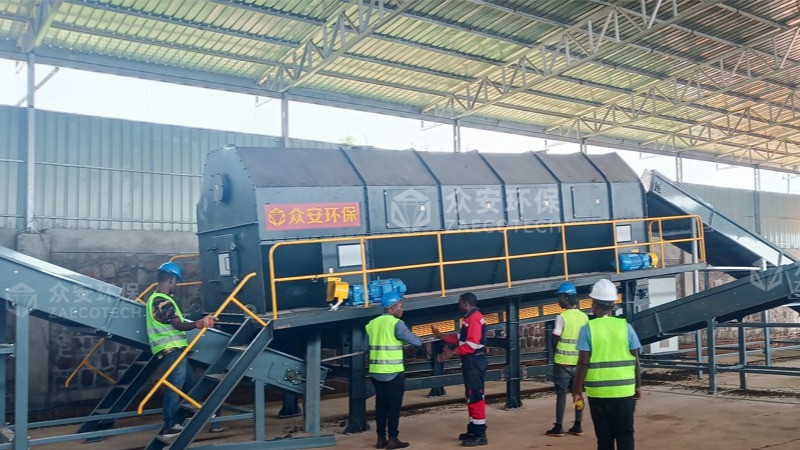
The project included:
Feeding apron conveyor
Bag breaker
Belt conveyors
Magnetic separator
Trommel screen
Online recyclables sorting platform
Baling machine
Through the sorting process, the system can separate:
Waste paper
Metal cans
Glass bottles
Plastic bottles
Usable clothing
Other recyclable materials
The project demonstrates how mechanical sorting technology can support waste resource recovery and improve recycling efficiency in overseas waste treatment facilities.
Mechanical sorting improves access to recyclable materials and increases recovery opportunities.
By separating recyclable and reusable materials, less waste requires final disposal.
Recovered plastics, metals, paper, and other materials can be redirected into recycling industries.
Compared with fully manual sorting, automated equipment provides more consistent processing capacity for large waste volumes.
Selecting the right sorting system requires considering several factors.
Different regions have different waste characteristics. The system should be designed according to local waste analysis.
Project capacity may vary depending on population, collection volume, and future expansion plans.
Some projects focus on recyclable material recovery, while others require RDF production or waste volume reduction.
The right balance between mechanical equipment and manual sorting depends on investment plans and operating requirements.
ZAECOTECH provides customized municipal solid waste sorting solutions for different countries and waste treatment projects.
By integrating feeding systems, bag opening, screening, magnetic separation, sorting, and baling equipment, ZAECOTECH helps customers build efficient waste recovery systems based on actual project conditions.
For Africa and other overseas markets, customized MSW sorting systems can improve recycling efficiency, reduce disposal pressure, and support sustainable waste management development.
A municipal solid waste sorting machine provides an effective solution for Africa waste projects by transforming mixed municipal waste into valuable recyclable resources.
Through customized sorting technology and complete system integration, waste treatment facilities can improve recovery efficiency, reduce landfill dependence, and create a more sustainable waste management process.


 中文


