

A pallet and wood waste shredder machine helps recycling facilities process discarded wooden pallets, packaging wood, timber offcuts, and other suitable wood waste into smaller, more manageable pieces. For businesses handling large volumes of waste pallets, choosing the right shredder is essential for improving feeding efficiency, reducing material volume, and preparing wood for further recycling.
However, not all wood waste has the same processing requirements. Wooden pallets may contain nails and metal fasteners, while their dimensions, structural strength, and moisture content can vary significantly. An effective shredding solution must therefore match the material characteristics, required throughput, target output size, and downstream recycling process.
This guide explains how to select an industrial wood shredder, what equipment features matter most, and how to configure a practical pallet recycling system.
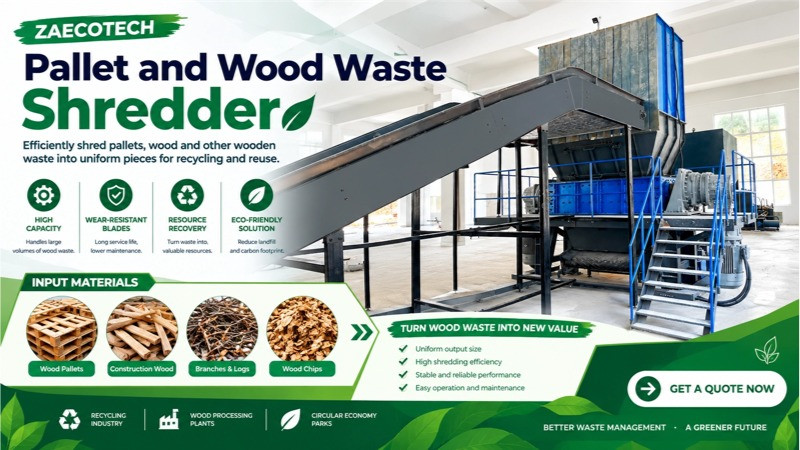
Before selecting a machine, identify the type and condition of the wood waste you need to process.
Common materials include:
Waste wooden pallets from warehouses and logistics centers
Broken or discarded transport pallets
Wooden crates and packaging materials
Timber boards and wood offcuts
Suitable wood-processing residues
Three factors deserve particular attention.
Pallet dimensions: Large pallets may require a wide feeding opening and a heavy-duty conveyor to ensure stable feeding.
Metal contamination: Nails, screws, and other metal fasteners can increase cutting tool wear. The shredder and downstream separation equipment should be selected with the actual metal content in mind.
Material condition: Moisture, wood thickness, structural strength, and the presence of coatings or contaminants can affect processing performance.
Providing photographs, maximum material dimensions, and representative samples helps the manufacturer recommend a suitable configuration.
The right shredder depends on the material, target output size, and required production capacity.
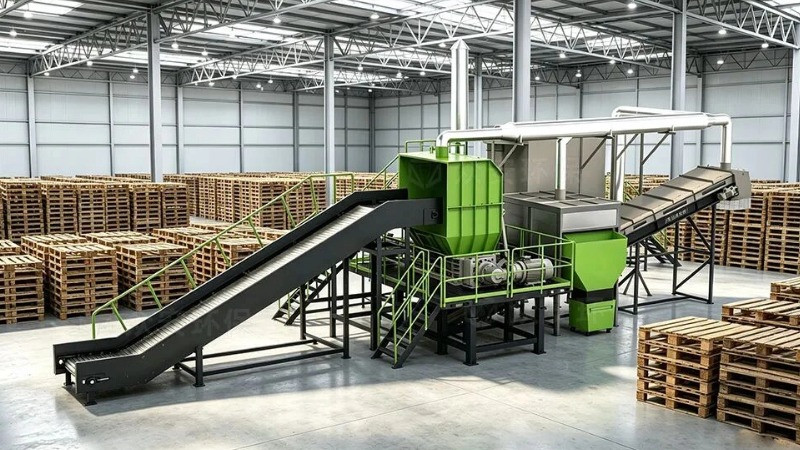
A double-shaft shredder uses two rotating shafts to shear and tear materials into smaller pieces. It is a practical option for bulky wooden pallets and mixed wood waste that require primary size reduction.
Its key advantages include:
High-torque shearing for bulky materials
Heavy-duty construction for demanding industrial applications
Adaptability to different pallet sizes and feeding arrangements
Integration with conveyors and magnetic separation equipment
For operations processing intact or irregular pallets, a double-shaft shredder is often worth evaluating as the primary machine.
If the shredded wood must meet a smaller particle-size requirement, additional crushing or shredding may be necessary. The need for a second stage depends on the intended application, the required particle size, and the performance of the primary shredder.
The best solution is not necessarily the machine with the smallest output. It is the configuration that reliably meets the required material specifications without adding unnecessary processing stages.
Equipment capacity and output size are two of the most important factors in selecting a pallet and wood waste shredder machine.
ZAECOTECH's industrial waste shredder page lists the following reference specifications:
| Parameter | Reference specification |
|---|---|
| Processing capacity | 10–60 m³/h |
| Output size | 50–200 mm |
| Motor power | 30–75 kW |
These are general product reference values, not guaranteed throughput for every type of wooden pallet. Actual performance depends on pallet dimensions, wood thickness, moisture content, feeding conditions, metal contamination, and the selected configuration.
The product series also lists the following capacity ranges for different models:
| Model | Reference capacity |
|---|---|
| A6W/120 | 10–20 m³/h |
| A9W/160 | 20–35 m³/h |
| A12W/180 | 30–45 m³/h |
| A15W/180 | 45–60 m³/h |
These figures should be used as an initial reference when comparing equipment. Final model selection requires confirmation against the actual feedstock and project requirements.
It is also important to distinguish between cubic meters per hour (m³/h) and tons per hour (t/h). They measure different things. Converting one to the other requires the bulk density of the specific material, which can vary considerably depending on how the pallets are loaded and processed.
When selecting a machine, confirm the following:
The number and dimensions of pallets to be processed
The required daily or hourly throughput
The target output size
Whether the wood will undergo secondary shredding or screening
The space available for feeding, conveying, and discharge
Wooden pallets often contain nails, screws, and metal connectors. These components create additional challenges for shredding and downstream material recovery.
A suitable system should consider the following measures:
Wear-resistant cutting tools: Appropriate blade materials and cutting geometry help manage normal wear during wood processing.
Overload protection: Suitable control and protection functions help prevent abnormal operating conditions from causing unnecessary damage.
Magnetic separation: A magnetic separator can remove ferrous metal from the shredded material.
Accessible maintenance design: Practical access to wear parts can simplify inspection and servicing.
A magnetic separator does not replace proper equipment selection or eliminate every type of metal. Non-ferrous metals, such as aluminum, generally require different separation methods.
The amount and type of metal in the incoming pallets should therefore be assessed before finalizing the system design.
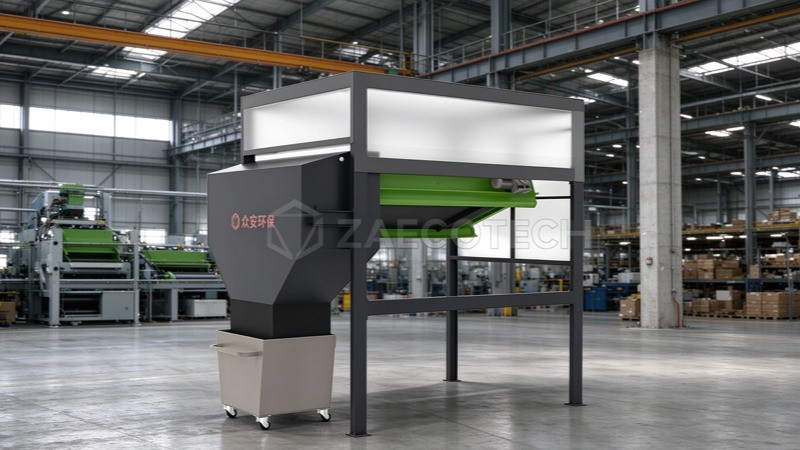
A wood shredder performs best when the feeding and discharge systems are designed around the material being processed.
For bulky wooden pallets, a heavy-duty chain-plate conveyor can help move materials into the shredder more consistently than an unsuitable light-duty feeding arrangement. Conveyor dimensions and loading methods should match the pallet size, expected throughput, and available floor space.
A typical pallet recycling process may follow this sequence:
Waste wooden pallets → Feeding conveyor → Double-shaft shredder → Magnetic separator → Discharge conveyor → Downstream processing
Each component serves a different purpose:
Feeding conveyor: Transfers bulky pallets into the shredding chamber.
Double-shaft shredder: Reduces the size of the wood waste.
Magnetic separator: Removes ferrous metal contaminants.
Discharge conveyor: Transfers the shredded material to storage or the next processing stage.
Depending on the required final product, the line may also include screening or secondary shredding.
Integrating these components can reduce manual material handling and improve process coordination. The exact arrangement should be determined by the site's layout, material flow, and production targets.
A complete pallet recycling line should be designed around the actual waste stream rather than assembled from equipment specifications alone.
For example, a facility processing large volumes of intact pallets may need a heavy-duty feeding conveyor, a double-shaft shredder, magnetic separation, and an automated control system.
A practical configuration process involves four steps.
Step 1: Assess the feedstock. Confirm pallet dimensions, wood condition, moisture content, metal fasteners, and any non-wood contaminants.
Step 2: Define the production target. Establish the required throughput and output size, along with any requirements for downstream fuel preparation or wood recycling.
Step 3: Match the equipment. Select the shredder model, conveyor dimensions, magnetic separator, and any secondary processing equipment.
Step 4: Plan the complete layout. Check feeding access, discharge height, maintenance clearance, electrical requirements, and material storage areas.
ZAECOTECH's industrial waste shredding solutions can be configured according to material characteristics, capacity requirements, and site conditions. A customized system helps ensure that the equipment works as a coordinated line rather than as separate machines.
To recommend an appropriate pallet and wood waste shredder machine, a manufacturer needs more than a general description such as “waste wooden pallets.”
Prepare the following information before requesting a proposal:
| Information | Why it matters |
|---|---|
| Material photographs or samples | Help identify the material structure and processing challenges |
| Maximum pallet dimensions | Help determine feeding opening and conveyor requirements |
| Material condition | Reveals whether pallets are intact, broken, wet, or contaminated |
| Metal content | Helps determine cutting protection and separation requirements |
| Target capacity | Guides model selection and line configuration |
| Required output size | Determines whether secondary processing is needed |
| Final application | Helps define the downstream material specifications |
| Site layout and power supply | Supports installation and system integration planning |
If the intended use is biomass fuel production, for example, the required output size and moisture specifications may differ from those for general wood waste volume reduction. The downstream application should be confirmed before selecting the final configuration.
The most suitable shredder is one that matches your material, operating conditions, and recycling objectives.
ZAECOTECH provides industrial shredding equipment and customized system solutions for solid waste pretreatment and resource recovery. Depending on the project, a pallet recycling system can incorporate heavy-duty feeding, double-shaft shredding, magnetic separation, conveying, and additional size-reduction equipment.
When evaluating a supplier, consider not only the machine's nominal capacity but also its suitability for your material, wear-part requirements, maintenance accessibility, control functions, and technical support.
ZAECOTECH provides technical assistance and can discuss customized configurations based on material samples, target throughput, output requirements, and site conditions.
To receive an equipment recommendation, prepare your pallet dimensions, estimated processing volume, metal contamination details, and required output size.
Choosing a wood pallet shredder machine requires a clear understanding of the material, production target, and downstream recycling process. A double-shaft shredder can be a suitable primary processing option for bulky wooden pallets, while conveyors and magnetic separation equipment help create a more integrated recycling system.
The key is to match the machine and supporting equipment to the actual feedstock instead of relying on capacity figures alone. With the right configuration, businesses can improve wood waste handling, reduce material volume, and prepare recovered wood for appropriate downstream use.
For a customized solution, share your material details and production requirements with ZAECOTECH to identify a suitable shredding system.


 中文


