

A biomass shredder for biogas plantfeeding helps reduce bulky agricultural residues into more manageable material for conveying, mixing, and anaerobic digestion. For biogas plant operators, long fibers, uneven particle sizes, and unstable feeding can complicate material handling and affect the consistency of the feeding process.
Common feedstocks include wheat straw, corn stalks, sugarcane bagasse, and other agricultural residues. Because these materials vary in size, moisture content, and fiber structure, they require suitable shredding and feeding configurations.
ZAECOTECH's biomass pre-shredding system combines size reduction with material conveying and optional secondary grinding to prepare biomass for downstream processing.
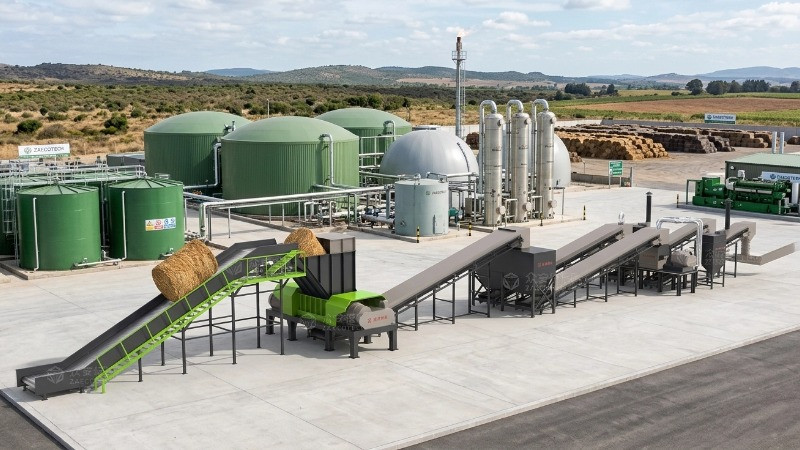
Raw biomass can be difficult to handle before it enters the digester.
Long fibers: Straw and stalks may wrap around equipment or cause feeding interruptions.
Uneven particle sizes: Whole stalks and bulky residues can complicate conveying and mixing.
Variable moisture content: Wet and dry materials behave differently during feeding and grinding.
Unstable material flow: Poorly prepared biomass may create difficulties for mixers, pumps, and pipelines.
A suitable pre-shredding system helps reduce these handling challenges. The equipment should be selected according to the feedstock characteristics, required throughput, and downstream process.
A biomass shredder uses cutting, shearing, or impact to reduce the size of raw materials. Primary shredding makes bulky biomass easier to convey and prepares it for further processing when necessary.
Key benefits include:
Reducing the size of long stalks and bulky residues.
Improving material handling and feeding consistency.
Supporting integration with conveyors, mixers, and secondary grinders.
Reducing reliance on repeated manual handling when combined with suitable automation.
Shredding is a mechanical pretreatment step, not a guarantee of higher biogas production. Its effect on digestion and methane yield depends on the feedstock, particle size, digester technology, and operating conditions.
ZAECOTECH biomass pre-shredding system specifications :
| Parameter | Reference specification |
|---|---|
| Processing capacity | 15–80 t/h |
| Primary output size | 50–150 mm |
| Main power range | 132–400 kW |
| Feeding options | Chain plate conveyor or grab loader |
| Equipment options | Dual-shaft shredder, swing hammer mill, secondary fine grinder |
| Control system | PLC control |
Actual capacity and output size depend on the material and system configuration.
For straw and corn stalks: A suitable feeding conveyor and primary shredder help manage long fibers and bulky feedstock.
For sugarcane bagasse: Moisture content and fiber structure should be assessed before selecting the shredding and conveying equipment.
For wood waste and bark: Material hardness, density, and cutter wear requirements are important selection factors.
For processes that require finer material, a secondary grinder may be added. But this is not a standard requirement for every biogas plant. The target size should match the downstream feeding and digestion process.
A typical feedstock preparation process may follow this sequence:
Raw material receiving → Feeding conveyor → Primary shredding → Optional screening or metal separation → Secondary grinding, if required → Mixing or pulping → Anaerobic digestion
Each stage depends on the material and plant requirements. Primary shredding reduces bulky material, while secondary grinding is used only when a smaller particle size is needed. Mixing and digestion equipment then process the prepared feedstock according to the plant's operating method.
After anaerobic digestion, the resulting biogas can be used for heat and power generation or upgraded to biomethane, depending on the facility.
The shredding system prepares the feedstock; it does not replace the digestion, gas treatment, or utilization equipment.
ZAECOTECH's straw-to-biogas project in Hunan, China, with the following details:
Materials: Agricultural straw and livestock manure.
Processing scale: 180,000 tons per year.
Application: Bio-natural gas production.
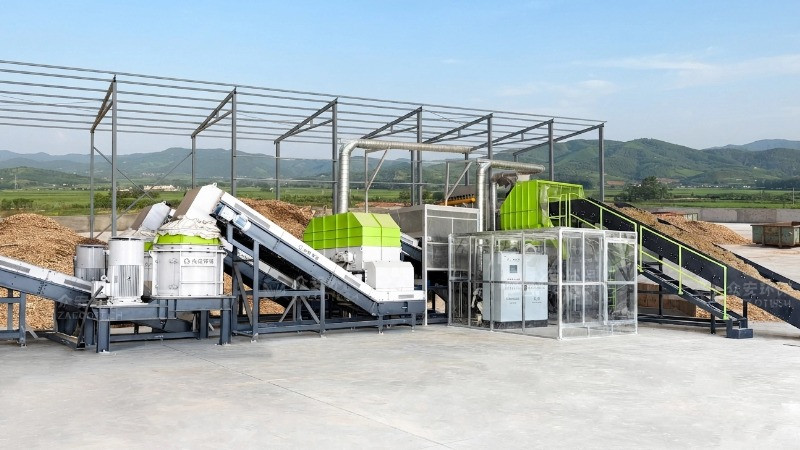
This project illustrates the scale of material handling required in large biomass utilization facilities. At this level, system design must consider feedstock receiving, conveying continuity, equipment coordination, and maintenance—not just the rated capacity of an individual shredder.
The required particle size and overall processing performance still depend on the complete system configuration and the characteristics of the incoming materials.
The best output size is the one that meets the next stage's requirements without unnecessary energy consumption or equipment complexity.
Primary conveying: Coarser shredded biomass may be sufficient when the downstream equipment accepts larger particles.
Mixing and wet feeding: Smaller particles may be required depending on the mixer, pump, pipeline, and feed mixture.
Fine processing: A secondary grinder can be considered when the process requires more finely prepared biomass.
Smaller particles are not always better. The final specification should balance feedstock handling, downstream requirements, energy use, and maintenance.
To select a suitable system, provide us with the following information:
Feedstock: Straw, corn stalks, bagasse, wood waste, or mixed biomass.
Material condition: Loose or baled, wet or dry, with approximate moisture content if available.
Required capacity: Tons per hour or tons per day.
Target output size: The particle size required by downstream equipment.
Downstream process: Mixing, wet or dry anaerobic digestion, or other preparation steps.
Site conditions: Available space and existing feeding or conveying equipment.
ZAECOTECH provides customized biomass shredding and pretreatment solutions, with equipment configurations based on feedstock characteristics and plant requirements.
Planning a biomass feedstock preparation project? Contact ZAECOTECH to discuss your material, required capacity, output size, and downstream process.


 中文


