

Rapid urbanization, accelerating consumerism, and shifting demographic patterns have combined to generate unprecedented volumes of municipal solid waste (MSW) worldwide. From mixed household refuse, commercial packaging, and bulky items to industrial scrap, synthetic textiles, and complex polymers, urban waste streams are exceptionally heterogeneous and unpredictable. Managing this massive refuse efficiently is one of the most critical environmental, sanitary, and logistical challenges facing modern metropolitan areas. Landfilling raw, un-shredded urban waste wastes valuable land and accelerates ecological degradation, while incineration without proper pre-processing leads to unstable combustion, high emissions, and frequent equipment downtime.
Achieving true circularity and high material diversion rates requires advanced mechanical size-reduction infrastructure and intelligent sorting technology. Transforming raw, messy urban waste into clean, homogeneous fractions—such as recyclable polymers, ferrous and non-ferrous metals, paper fiber, and Refuse-Derived Fuel (RDF)—demands robust, purpose-built machinery. Deploying advanced rotary shear shredders allows urban recycling plants to maximize operational efficiency, streamline downstream optical sorting, and achieve high recovery yields. This technical guide examines urban waste rheology, low-speed high-torque cutting kinematics, wear-resistant metallurgy, and plant integration layouts for maximizing efficiency in urban waste recycling.
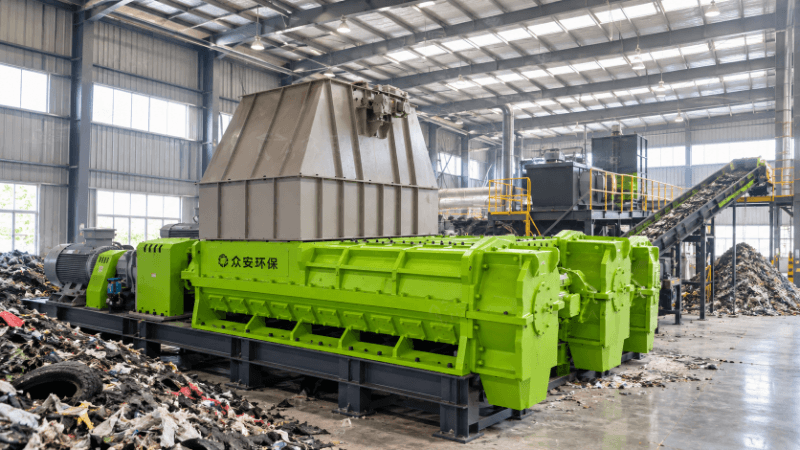
To understand how advanced rotary shear shredders optimize urban waste recycling, one must first analyze the physical and mechanical hurdles inherent in mixed municipal refuse:
Extreme Heterogeneity: Urban waste streams combine rigid plastics, abrasive glass cullet, flexible films, wet organic matter, abrasive sand, and heavy metal components into a single unpredictable feed matrix.
Bulky and Unsorted Geometry: Large household items, furniture fragments, mattresses, and tangled plastic wrap frequently enter the waste stream, threatening to bridge hoppers and jam downstream conveyors.
Uncrushable Tramp Elements: Mixed municipal waste invariably contains heavy steel components, concrete blocks, and automotive parts that act as destructive impact hazards for conventional high-speed crushers.
Thermal and Wrapping Vulnerabilities: Flexible films and synthetic textiles wrap around high-speed shafts, generating intense frictional heat that melts polymers into gummy masses that lock up drive motors.
Maximizing efficiency in urban waste processing requires a synchronized mechanical design focused on active hydraulic feeding, positive shear cutting, and complete shaft isolation:
To eliminate material bridging and ensure consistent feeding of voluminous or bulky urban waste, advanced rotary shredders utilize an active, horizontal hydraulic pusher ram. Guided by real-time motor load telemetry via the central PLC, the ram compresses piles of loose refuse firmly against the rotating cutting drum at a controlled, steady rate, preventing surge conditions and ensuring uniform material presentation.
Operating at 60 to 90 RPM via heavy-duty planetary gearboxes, the solid-steel rotor features precision-milled pocket housings holding square indexable cutting inserts. These tools pass against adjustable stationary bed knives with a tight micro-gap clearance (0.5 mm to 1.0 mm), producing a clean scissor cut that severs tough materials instantly rather than tearing or melting them.
Curved perforated screen cradles positioned immediately beneath the cutting rotor act as absolute mechanical gates. Material remains in the cutting chamber until sheared down to dimensions small enough to pass through the apertures (typically 30 mm to 100 mm), ensuring exact particle size uniformity required for downstream sorting.
The core defense against shaft wrapping and bearing failure is advanced end-plate isolation. Rotary shear shredders incorporate multi-stage grease-purged labyrinth seals and mechanical deflector plates between the cutting chamber and outboard bearing housings, completely blocking fine dust, moisture, and stringy lint.
The table below summarizes mechanical durability, cutting precision, output uniformity, and operational uptime across generic waste crushers versus advanced rotary shear shredders in urban waste recycling:
| Performance Metric | Generic Waste Crushers / Hammer Mills | Advanced Rotary Shear Shredders |
|---|---|---|
| Cutting & Sizing Mechanism | High-speed impact against grates; prone to instant jamming from tramp metal. | Low-Speed Rotary Shear with closed perforated sizing screens. |
| Wear Resistance & Metallurgy | Standard steels suffer rapid abrasive scouring from glass cullet and grit. | Hardox 500 Armoring & D2/DC53 Steels designed for abrasive solid waste. |
| Output Uniformity | Erratic particle distribution with excessive dust and stringy fragments. | Uniform Flakes & Chunks optimized for automated optical sorting. |
| Feed & Overload Reliability | Frequent catastrophic failures and motor burnouts from bulky items. | Active Hydraulic Pusher Rams & Auto-Reversing Drives ensuring continuous uptime. |
Processing abrasive mixed urban waste—frequently containing glass cullet, sand, grit, and metallic debris—subjects internal shredder components to continuous sliding friction and severe impact shock:
Vacuum-Hardened D2 / DC53 Tool Steels: Cutting inserts and bed knives are forged from high-carbon, high-chromium tool steels heat-treated to 56–58 HRC, ensuring long service life and edge retention under continuous multi-shift operation.
Four-Way Indexable Cutting Inserts: Square concave cutters can be rotated 90 degrees when an edge shows wear, multiplying usable blade service life fourfold before requiring workshop regrinding or replacement.
Hardox 500 Chamber Armoring: Internal sidewalls, feed hoppers, and screen cradles are lined with bolted, replaceable Hardox 500 wear plates, protecting the structural chassis from abrasive scouring.
Outboard Bearing Isolations: Heavy-duty spherical roller bearings are housed externally in split plummer blocks separated from the cutting chamber by open air gaps and multi-stage grease-purged labyrinth seals to block moisture and fine dust.
A high-performance urban recycling facility integrates advanced rotary shear shredders into a synchronized, continuous production line:
Stage 1: Waste Reception and Bag Opening: Municipal collection trucks dump mixed urban refuse into receiving bunkers, where overhead cranes and metering drums feed bag-opening trommels.
Stage 2: Precision Rotary Shear Shredding: The hydraulic pusher ram feeds bulky waste components into the low-speed rotary shear, homogenizing particle dimensions to prepare material for optical sorting.
Stage 3: Advanced Sorting and RDF Production: Cleanly liberated materials flow past magnetic separators, eddy current units, and optical sorters, recovering clean recyclables while routing combustible fractions to Refuse-Derived Fuel (RDF) preparation lines.
Operating municipal and urban waste processing facilities under continuous multi-shift schedules requires rigorous environmental and safety engineering:
Odor Suppression and Negative Pressure Air Handling: Tipping halls and primary processing buildings operate under negative pressure, ducting exhaust air through biofilters and wet scrubbers to neutralize organic odors and volatile organic compounds (VOCs).
Optical Spark Detection and Fire Suppression: Dry fractions and lithium-ion batteries present fire risks in urban waste streams. Infrared sensors positioned along conveyor lines trigger atomizing water foggers within milliseconds to suppress ignition.
Intelligent Reversing Drivetrains: If an uncrushable heavy metallic object enters the cutting chamber, the central PLC detects the electrical torque spike within milliseconds and executes an automatic reverse cycle to clear the obstruction.
Successfully processing mixed municipal and urban solid waste requires moving away from crude, un-sorted dumping toward advanced mechanical and optical recycling infrastructure. Deploying advanced rotary shear shredders—engineered with active hydraulic pusher rams, low-speed high-torque cutting kinematics, Hardox wear armoring, and intelligent automated sorting loops—enables modern recycling facilities to transform messy urban refuse into clean, high-value raw materials. This robust engineering approach ensures high diversion rates, strict environmental compliance, and long-term economic viability for urban waste management operations.


 中文


