

The global fashion and apparel industries generate tens of millions of tons of pre-consumer garment offcuts and post-consumer waste clothing annually. From discarded fast-fashion garments, denim jeans, and wool sweaters to mixed-blend knitwear and institutional textiles, this massive stream of fibrous refuse represents a complex disposal challenge. Historically, the vast majority of unwanted clothing was sent to municipal landfills or incinerated, representing an immense loss of valuable natural and synthetic fiber resources. Today, accelerating environmental regulations, tightening carbon-border tariffs, and surging consumer demand for circular fashion have made industrial textile and garment recycling an operational priority.
Transforming tough, heterogeneous post-consumer garments into uniform, high-grade recycled fibers requires advanced mechanical size reduction. However, conventional waste crushers and high-speed hammer mills fail entirely when confronted with textiles' high tensile strength, elasticity, and multi-component attachments (such as metal zippers, brass buttons, rivets, and synthetic thread), leading to catastrophic shaft wrapping, frictional heat buildup, and mechanical seizure. Overcoming these barriers requires purpose-built technology. Deploying specialized rotary shear shredders engineered with low-speed high-torque cutting kinematics, active hydraulic ram feeding, anti-wrapping shaft seals, and calibrated sizing screens allows recycling plants to convert post-consumer and industrial waste garments into pristine, uniform raw materials. This technical guide examines textile waste rheology, rotary shear kinematics, wear-resistant metallurgy, and plant integration layouts for transforming waste clothes into recyclable textile fibers.
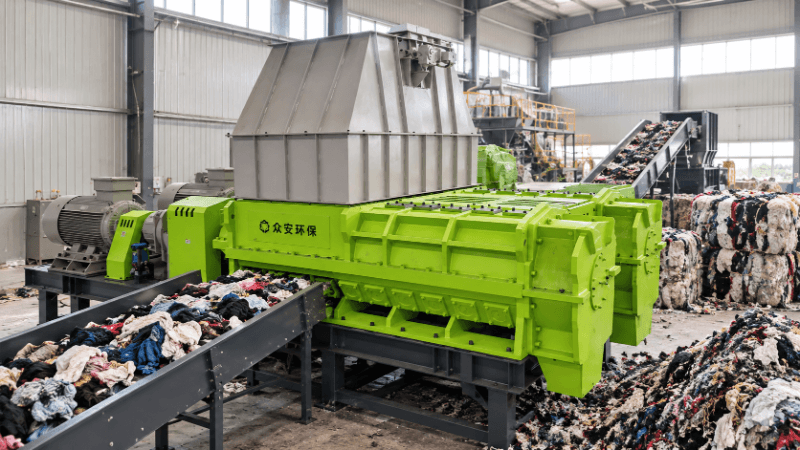
To understand why specialized machinery is mandatory for garment recycling, one must analyze the physical and mechanical hurdles inherent in post-consumer clothing waste:
High Tensile Tenacity and Elongation: Natural and synthetic fibers—such as cotton, wool, polyester, nylon, and blended yarns—exhibit exceptional tear resistance and tensile elasticity, stretching significantly under mechanical load rather than fracturing cleanly under blunt impact.
Centrifugal Coiling and Shaft Wrapping: As conventional high-speed rotors spin, loose fabric strips, sleeves, and garment panels are driven centrifugally outward, sliding along the rotor body and wedging tightly into open gaps between the rotating drum and stationary end-walls.
Thermal Frictional Binding: Once a tight layer of synthetic garment scraps or blended fabrics coils around a rotating shaft, continuous sliding friction generates intense thermal buildup. This heat can melt synthetic polymer blends into a gummy, rock-hard mass that locks up drive motors and blinds discharge screens.
Heterogeneous Hardware Contamination: Post-consumer garments frequently contain metal zippers, heavy-duty buttons, rivets, and synthetic labels that act as uncrushable tramp elements, destroying unprotected cutting blades.
Processing tough, stringy waste clothes and garments into uniform, high-purity recycled fibers requires a synchronized mechanical design focused on active hydraulic feeding, positive shear cutting, and complete shaft isolation:
To eliminate material bridging and ensure consistent feeding of voluminous or baled garments and fabric scraps, heavy-duty industrial shredders utilize an active, horizontal hydraulic pusher ram. Guided by real-time motor load telemetry via the central PLC, the ram compresses piles of loose waste firmly against the rotating cutting drum at a controlled, steady rate, preventing surge conditions and ensuring uniform material presentation.
Operating at 60 to 90 RPM via heavy-duty planetary gearboxes, the solid-steel rotor features precision-milled pocket housings holding square indexable cutting inserts. These tools pass against adjustable stationary bed knives with a tight micro-gap clearance (0.5 mm to 1.0 mm), producing a clean scissor cut that severs tough fiber bundles and multi-layer seams instantly rather than tearing or melting them.
Curved perforated screen cradles positioned immediately beneath the cutting rotor act as absolute mechanical gates. Textile fragments remain in the cutting chamber until sheared down to dimensions small enough to pass through the apertures (typically 15 mm to 50 mm), ensuring exact particle size uniformity required for downstream fiber defibrillation or carding lines.
The core defense against shaft wrapping and bearing failure is advanced end-plate isolation. Garment recycling shredders incorporate multi-stage grease-purged labyrinth seals and mechanical deflector plates between the cutting chamber and outboard bearing housings, completely blocking fine lint, dust, and stringy threads.
The table below summarizes mechanical durability, cutting precision, output uniformity, and operational uptime across generic waste crushers versus specialized rotary shear shredders for waste clothing processing:
| Performance Metric | Generic Waste Crushers / Hammer Mills | Specialized Rotary Shear Garment Shredders |
|---|---|---|
| Cutting & Sizing Mechanism | High-speed impact against grates; prone to fiber choking and thermal binding. | Low-Speed Rotary Shear with closed perforated sizing screens. |
| Wear Resistance & Metallurgy | Standard steels suffer rapid abrasive scouring from mineral dirt, buttons, and zippers. | Hardox 500 Armoring & D2/DC53 Steels designed for tough fibrous scrap. |
| Output Uniformity | Erratic particle distribution with excessive dust and stringy fragments. | Uniform Flakes & Fibers optimized for textile regeneration and carding. |
| Feed & Anti-Wrapping Reliability | Frequent wrapping, thermal melting, and feeding bottlenecks with baled garments. | Active Hydraulic Pusher Rams & Labyrinth Seals preventing coiling. |
Processing abrasive post-consumer garments—often containing embedded mineral dust, metallic zippers, and buttons—subjects internal shredder components to continuous sliding friction and severe impact shock:
Vacuum-Hardened D2 / DC53 Tool Steels: Cutting inserts and bed knives are forged from high-carbon, high-chromium tool steels heat-treated to 56–58 HRC, ensuring long service life and edge retention under continuous multi-shift operation.
Four-Way Indexable Cutting Inserts: Square concave cutters can be rotated 90 degrees when an edge shows wear, multiplying usable blade service life fourfold before requiring workshop regrinding or replacement.
Hardox 500 Chamber Armoring: Internal sidewalls, feed hoppers, and screen cradles are lined with bolted, replaceable Hardox 500 wear plates, protecting the structural chassis from abrasive scouring.
Outboard Bearing Isolations: Heavy-duty spherical roller bearings are housed externally in split plummer blocks separated from the cutting chamber by open air gaps and multi-stage grease-purged labyrinth seals to block fine textile lint and dust.
A high-performance garment recycling facility integrates a heavy-duty rotary shear shredder into a synchronized, continuous production line:
Stage 1: Waste Reception and Sorting: Bales of post-consumer clothing are unbundled, manually or optically sorted to remove hazardous non-textile items, and loaded onto heavy slat conveyors feeding the shredder hopper.
Stage 2: Precision Rotary Shear Shredding: The hydraulic pusher ram feeds material into the low-speed rotary shear, cleanly slicing tough garments against bed knives and passing them through calibrated bottom sizing screens.
Stage 3: Magnetic Separation and Pneumatic Transfer: Shredded textile flakes pass over cross-belt magnets to remove ferrous buttons, zippers, and rivets, before being pneumatically conveyed to downstream opening mills, carding machines, or spinning preparation lines.
Operating textile and garment processing facilities under continuous multi-shift schedules requires rigorous safety interlocks, dust filtration, and fire prevention systems:
Optical Spark Detection and Water Quenching: Dry textile lint and friction sparks create severe fire risks. Infrared sensors positioned along conveyor drops trigger atomizing water foggers within milliseconds to suppress ignition.
Enclosed Pulse-Jet Dust Collection: Connecting all discharge chutes to a negative-pressure pulse-jet baghouse filtration system captures fine airborne lint and particulate matter, maintaining a clean, explosion-safe working environment.
Intelligent Reversing Drivetrains: If an uncrushable heavy metallic object enters the cutting chamber, the central PLC detects the electrical torque spike within milliseconds and executes an automatic reverse cycle to clear the obstruction.
Successfully recycling waste clothes and post-consumer garments requires moving away from crude, generic waste crushers toward specialized mechanical engineering. Deploying heavy-duty rotary shear shredders—engineered with active hydraulic pusher rams, low-speed high-torque cutting, multi-stage anti-wrapping labyrinth seals, and calibrated sizing screens—solves the persistent problems of high tensile tenacity, shaft wrapping, and thermal binding. This robust engineering approach ensures high operational uptime, strict environmental compliance, and long-term economic viability for the global textile recycling sector.


 中文


