

Establishing an industrial size-reduction facility is a complex engineering and capital undertaking. Whether processing municipal solid waste (MSW), commercial and industrial (C&I) scrap, bulky furniture, scrap metal, end-of-life tires, or alternative fuels (RDF/SRF), plant managers and engineering procurement contractors (EPCs) face a delicate balance: maximizing hourly output while curbing energy draw and tooling wear. Undersized processing equipment creates persistent bottlenecks, frequent drivetrain overloads, and high maintenance costs. Conversely, over-specifying machinery leads to excessive initial capital expenditures (CAPEX) and inefficient, high-idle electrical loads.
Accurately sizing a high-yield industrial shredding plant requires matching raw feed dynamics to cutting chamber geometries, powertrain architectures, and material liberation targets. By thoroughly analyzing the relationship between throughput, power consumption, and ROI, operators can design a balanced, resilient size-reduction line that optimizes electrical efficiency and speeds capital payback. This technical guide outlines the core engineering calculations, drivetrain comparisons, energy management methodologies, and lifecycle economic models required for commercial industrial shredder installations.
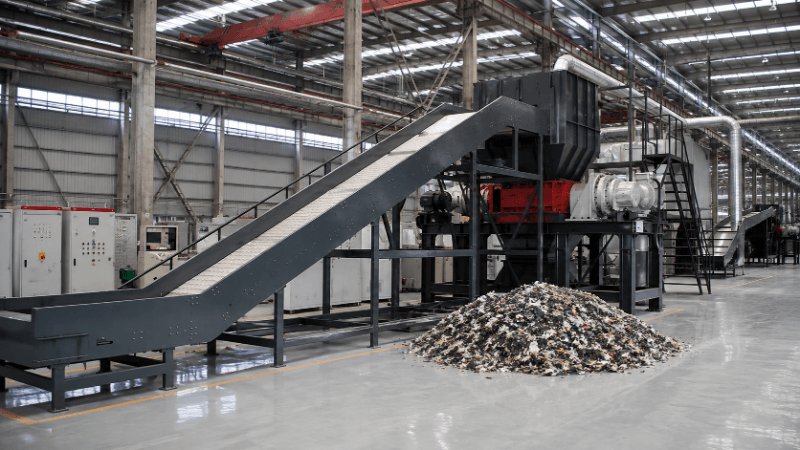
Machine sizing begins with an analysis of inbound feedstock bulk density, moisture content, tensile strength, and piece dimensions. Selecting the right processing platform requires defining how the material behaves under mechanical shear:
Voluminous & Hollow Bulky Feeds: Items such as 1,000L IBC totes, blue plastic drums, foam sofas, spring mattresses, and shipping pallets have low uncompacted bulk densities (50 to 120 kg/m³). Sizing depends primarily on cutting chamber mouth dimensions and shaft hook draw-down profiles rather than peak shear force, preventing material bridging over the rotors.
High-Tensile & Elastic Feeds: Scrap truck tires, agricultural films, baled woven polyolefin bags (FIBCs), and synthetic carpets flex and stretch under load. These streams require sharp scissor clearances (0.5 to 1.0 mm) and high torque per unit knife width to slice fibers cleanly without wrapping or dragging along the chamber walls.
Dense, Rigid Scrap & Purging Lumps: Thick-walled pipe offcuts, solid plastic extruder purge lumps, and light scrap metals carry high bulk densities (400 to 1,200 kg/m³). These demand high instantaneous shear forces, rigid forged hexagonal drive shafts, and load-sensing hydraulic pusher rams to meter solid masses against the cutting rotor without stalling.
The choice of drivetrain directly dictates energy efficiency, instantaneous torque availability, and machine resilience under shock impact loading:
| Drivetrain Parameter | Mechanical Gearbox Drive (VFD Motor + Planetary) | Electro-Hydraulic Drive (Hydraulic Motor + Pump) |
|---|---|---|
| Base Energy Efficiency | High (88% to 94%): Minimal transmission losses through hardened planetary gears. | Moderate (72% to 82%): Hydraulic oil circulation, valve throttling, and heat dissipation create parasitic losses. |
| Starting & Peak Torque | High torque delivered via Variable Frequency Drive (VFD) and high reduction ratios. | Maximum torque from zero RPM; ideal for continuous heavy shock loads and uncrushable tramp metals. |
| Shock Load Dampening | Managed via mechanical slip clutches, fluid couplings, or millisecond PLC auto-reverse cycles. | Natural fluid dampening; hydraulic relief valves vent instantly during severe overloads to protect internal shafts. |
| Maintenance Complexity | Low: Periodic synthetic gear oil changes and mechanical seal inspections. | Moderate to High: Requires continuous hydraulic oil filtration, hose replacements, cooling radiator upkeep, and valve calibration. |
| Primary Application | RDF fine sizing, plastic granulators, general municipal solid waste, and dry commercial refuse. | Heavy car body scrap, oversized truck tires, solid plastic purge blocks, and unpredictable demolition bulky waste. |
Plant energy performance is measured by Specific Energy Consumption (SEC), which calculates the kilowatt-hours required to process one metric ton of material:
Specific Energy Consumption (SEC in kWh/ton) = Average Operating Power (kW) ÷ Hourly Throughput (tons/hour)
Where Average Operating Power (kW) represents the real-time electrical load drawn by the cutting motor under steady feed, and Hourly Throughput is continuous plant production in metric tons per hour.
Low-speed, high-torque double-shaft shredders shearing mixed MSW, wood scrap, or commercial refuse to a coarse size (150 to 300 mm) typically consume between 5.0 and 9.0 kWh/ton. Because there is no internal sizing screen underneath the cutting chamber, shredded chunks drop freely via gravity, eliminating parasitic friction and keeping electrical consumption low.
High-performance single-shaft shredders fitted with internal sizing screens (e.g., 25 to 40 mm mesh) for RDF fluff manufacturing or plastic flake production require significantly higher energy densities: typically 18.0 to 35.0 kWh/ton. Material circulates inside the cutting chamber until particles match the screen aperture, increasing internal friction and electrical demand.
Attempting to reduce oversized, heterogeneous waste down to a fine caliber (< 30 mm) within a single processing machine is inefficient. A single unit tasked with high reduction ratios suffers from severe knife wear, frequent overload stoppages, and elevated energy consumption. A high-yield processing line separates size reduction into synchronized stages:
Stage 1: Primary Coarse Reduction (Twin-Shaft Shredder): Operates at 12 to 20 RPM with heavy, multi-hook alloy discs to slice bulk streams into uniform 100 mm to 200 mm strips. This stage homogenizes material flow, untangles long wires, and exposes tramp metal contaminants.
Stage 2: In-Line Ferrous & Non-Ferrous Extraction: High-gradient overband magnetic separators and eddy current separators extract metals from the single-layer discharge belt, protecting downstream high-speed cutters from catastrophic blade impact.
Stage 3: Secondary Fine Granulation (Single-Shaft Shredder): An open rotor spinning at 80 to 140 RPM equipped with indexable square cutting inserts shears the pre-shredded material against adjustable bed knives, screening particles down to < 30 to 50 mm at high electrical efficiency.
Calculating the true economic return of an industrial shredder plant requires evaluating total cost of ownership (TCO) across a 5-to-10-year operating horizon rather than focusing solely on upfront machine acquisition price:
| Financial Dimension | Undersized / Low-CAPEX Entry Machine | Properly Sized Heavy-Duty Industrial Shredder |
|---|---|---|
| Initial Capital Outlay (CAPEX) | 30% to 50% lower initial acquisition cost. | Higher initial investment in heavy chassis, forged shafts, and planetary gearboxes. |
| Electrical Operating Expense (OPEX) | High: Motors run continuously near peak current; high non-productive idle and reverse cycling. | Optimized: High-torque operation at steady load; lower average kWh/ton consumption. |
| Tooling & Blade Wear Life | Rapid edge rounding on mild-grade alloys; blade replacements required every 400 to 700 hours. | Extended: Vacuum-hardened forged D2 / 1.2379 / DC53 alloys provide 2,000 to 3,500+ hours between turn/rebuild cycles. |
| Unscheduled Downtime | Frequent: Jamming on tough items, uncrushable metal damage, and motor thermal cutouts. | Minimal: Automated millisecond PLC auto-reverse cycles and outboard spherical roller bearings maintain 90%+ uptime. |
| Net Return on Investment (ROI) | Prolonged payback (36 to 48+ months) driven by repair bills and lost production capacity. | Rapid payback (14 to 24 months) achieved through reliable continuous output and low operating overhead. |
Sustaining high hourly tonnage and protecting machine components over multi-shift operations depends on integrated diagnostic systems:
Smart Real-Time Current Monitoring: Modern PLC systems track motor current phase balances and power factor at millisecond intervals. When encountering an uncrushable structural steel beam or oversized forging, the system stops forward rotation within 50 milliseconds and executes an automatic reverse cycle, clearing the chamber before drive damage can occur.
Thermal Bearing Telemetry: Outboard spherical roller bearings are fitted with PT100 resistance temperature detectors (RTDs) and vibration transducers. Continuous telemetry alerts maintenance crews to bearing lubrication breakdown, misalignment, or shaft deflection well before catastrophic failure.
Hydraulic Hopper Pusher Optimization: Single-shaft shredders utilize load-sensing proportional hydraulic rams to feed material against the rotor. Rather than pushing continuously, the ram automatically adjusts pressure based on cutting motor amperage, keeping motor loading steady and preventing chamber choke conditions.
Achieving profitable, high-throughput waste size reduction requires a disciplined engineering approach to plant sizing. By evaluating material rheology, comparing planetary electromechanical and electro-hydraulic drivetrains, balancing coarse pre-shredding against fine secondary sizing, and tracking specific energy consumption (kWh/ton), plant operators can design a robust industrial shredding system that handles peak loads with minimal downtime. Properly matching drive power and cutting chamber geometry to real-world feedstock parameters controls ongoing operational expenses, prevents premature tool wear, and delivers a predictable, rapid return on investment.


 中文


