

Choosing the right garbage separation equipment supplier is important for building an efficient waste sorting system. Mixed garbage often contains plastics, paper, organic matter, metals, stones, and other materials with different sizes, weights, and physical properties.
A reliable supplier should provide more than individual sorting machines. The right combination of screening, air separation, and intelligent sorting equipment can improve material recovery, reduce manual sorting, and create a more efficient waste processing system.
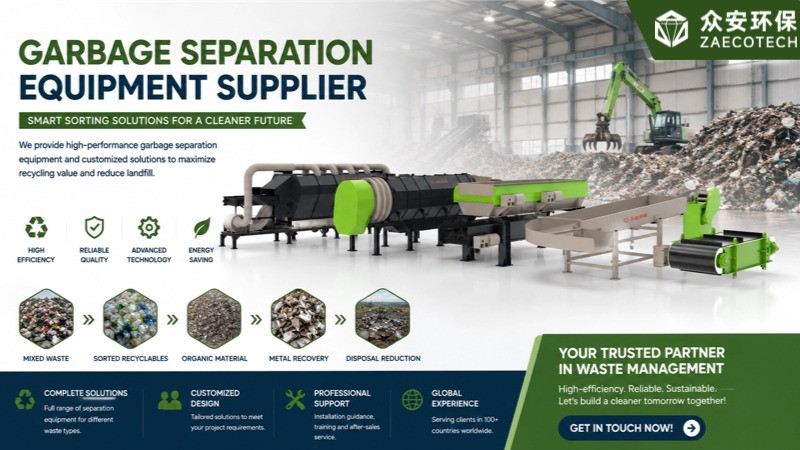
Different waste streams require different separation methods. A professional garbage separation equipment supplier should be able to match the equipment with the material characteristics and processing requirements.
A trommel screen uses a rotating drum to separate materials according to particle size. Smaller materials pass through the screen openings, while larger materials continue to the downstream process.
It is suitable for initial classification in municipal solid waste, construction waste, composting, and other recycling applications.
An air separator uses controlled airflow to separate lightweight materials from heavier fractions. Plastic films, paper, textiles, and other light materials can be separated from heavier materials such as stones, soil, and metals.
It is particularly useful when a waste stream contains a high proportion of lightweight combustible or recyclable materials.
A vibrating screen uses vibration to move materials across the screening surface and separate different particle sizes. It can help remove fine materials and improve the efficiency of downstream sorting.
This equipment is suitable for waste treatment and recycling systems where stable and continuous screening is required.
A disc screen provides continuous mechanical screening and classification of mixed materials. It can be used to separate fine fractions and improve material flow before subsequent sorting processes.
Its application can be selected according to the composition, particle size, and capacity requirements of the waste stream.
An AI sorting robot adds intelligent sorting capabilities to a recycling line. Using visual recognition and automated picking, it can identify and sort target materials from a moving waste stream.
This technology can reduce dependence on manual sorting and is especially useful when higher automation and more consistent sorting are required.
A complete garbage separation system normally combines several separation technologies rather than relying on one machine.
A typical process can be arranged as:
Mixed Garbage → Screening → Air Separation → Magnetic Separation → AI or Manual Sorting → Recyclable Materials
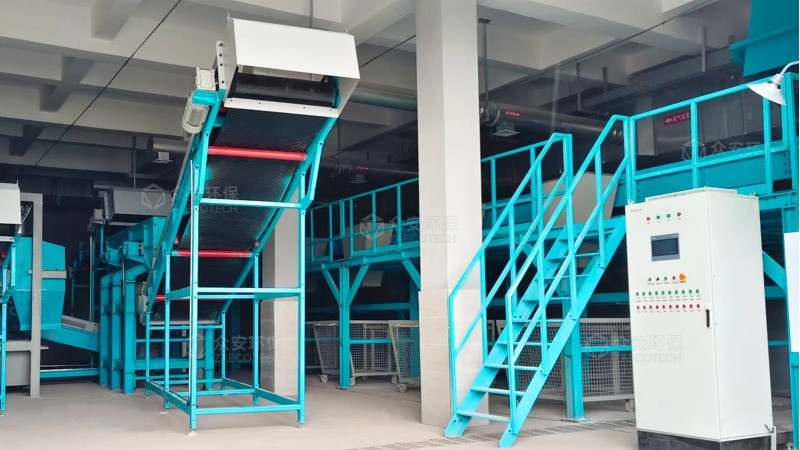
The exact configuration depends on the waste composition, required capacity, target recyclable materials, and final product requirements.
For example, screening can be used for initial size classification, while air separation removes lightweight materials. Magnetic separation can recover ferrous metals, followed by manual or AI sorting for more precise material recovery.
Therefore, equipment selection should be based on the complete process rather than the specifications of a single machine.
When comparing garbage separation equipment suppliers, several factors should be considered.
A supplier with screening, air separation, magnetic separation, and intelligent sorting equipment can provide better equipment matching for a complete recycling system.
Waste composition varies from one project to another. The supplier should be able to adjust equipment configuration according to material type, capacity, output requirements, and available site conditions.
The equipment should match the required throughput without creating bottlenecks in other sections of the production line.
Continuous waste processing requires durable equipment, stable operation, and convenient maintenance. Wear resistance and accessibility for maintenance are important considerations for long-term operation.
Installation guidance, commissioning, spare parts, operator training, and technical support can significantly affect the performance of a complete sorting system.
For large recycling projects, these services can be just as important as the initial equipment purchase.
ZAECOTECH provides a range of garbage separation equipment for different stages of waste sorting, including trommel screens, air separators, vibrating screens, disc screens, and AI sorting robots.
The equipment can be combined according to different waste processing requirements, allowing customers to develop customized sorting systems instead of relying on a fixed equipment configuration.
The main advantages include:
Complete waste separation equipment options
Customized equipment combinations
Screening and air separation technologies
Intelligent sorting solutions
Support for complete waste sorting systems
Technical and after-sales support
For projects requiring higher levels of automation, AI sorting can also be integrated with mechanical separation equipment to create a more intelligent waste sorting process.
The right garbage separation equipment supplier should provide more than a single sorting machine. Efficient waste recycling depends on selecting the right combination of screening, air separation, metal separation, and intelligent sorting technologies.
By matching equipment with waste characteristics, processing capacity, and final recycling goals, a properly designed garbage separation system can improve sorting efficiency, increase material recovery, and reduce manual processing requirements.
For new waste sorting plants or existing system upgrades, choosing a supplier with both equipment manufacturing and system integration capabilities can provide a more practical solution for long-term operation.


 中文


