

Municipal and commercial organic waste management is experiencing a rapid technological shift. Driven by landfill diversion mandates, corporate ESG targets, and the global expansion of industrial anaerobic digestion (AD) infrastructure, organic fraction processing has evolved into a high-value resource recovery sector. However, commercial kitchen scraps, post-consumer catering discards, and agro-food processing residues present extreme material-handling challenges. These wet waste streams combine high water contents, corrosive acidic fluids, tough fibrous matter, and unpredictable abrasive contaminants.
Deploying specialized heavy-duty food waste shredders is the critical initial stage in any continuous reclamation facility. Utilizing engineered high-torque pre-treatment for wet and fibrous organics homogenizes heterogeneous feeds, ruptures organic cellular structures to maximize methane production, and prevents downstream pump clogs and heat-exchanger fouling. This engineering guide examines organic feedstock characteristics, cutting chamber mechanics, corrosion-resistant metallurgy, multi-stage contaminant separation, and system optimization for commercial food waste processing facilities.
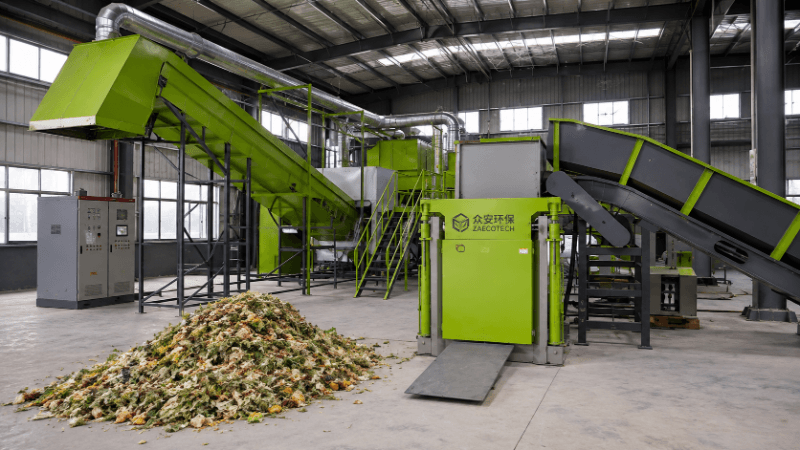
Commercial food waste cannot be processed like dry municipal solid waste or brittle industrial plastics. It is a dense, non-Newtonian mixture exhibiting unique rheological, chemical, and physical behaviors that place heavy continuous stress on size-reduction equipment:
Elevated Moisture Content (70%–85% by weight): Liquid-rich slurries easily blind standard screening meshes, cause cavitation in poorly designed hoppers, and penetrate dynamic bearing seals if shaft isolations are not hermetically sealed.
Fibrous and Elastic Plant Matter: Palm fronds, corn husks, pineapple tops, celery stalks, onion skins, and fibrous butcher trimmings resist blunt impact. Elastic plant fibers tend to wrap around cylindrical shafts, packing into clearances and causing localized friction heat and motor overloads.
Chemical Aggressiveness & Corrosion: Decomposing organic matter rapidly ferments into volatile fatty acids (VFAs) with pH levels dropping to 3.5–4.5, producing an aggressive electrochemical environment that erodes conventional mild carbon steels.
Abrasive & Uncrushable Inorganics: Commercial kitchen waste regularly contains dense bovine bones, oyster shells, ceramic tableware, stainless steel cutlery, broken glassware, and stone fruit pits that introduce severe mechanical shock loads to cutting tips.
Processing wet, acidic, and shock-heavy organic streams requires specialized machinery configurations designed for positive displacement, high cutting force, and corrosion resistance.
High-speed hammer mills and impact pulverizers are ill-suited for wet food waste because they atomize corrosive liquids, fling uncrushable cutlery violently, and generate extreme motor drag against fluid friction. An industrial twin-shaft food waste shredder operating at 10 to 25 RPM delivers maximum cutting torque. Counter-rotating shafts fitted with interlocking alloy cutting discs puncture, slice, and draw voluminous bulk waste downward through opposing scissor edges with open-bottom gravity discharge.
To eliminate shaft wrapping caused by fibrous plant materials, plastic packaging films, and packaging strings, the cutting chamber integrates precision-milled static scrapers:
Inter-Disc Comb Plates: Heavy-duty wear plates extend between adjacent cutting discs down to the core shaft root, continuously clearing trapped fibers out of the disc gullets.
Positive Drawdown Profile: The interaction between the rotary tooth and the stationary comb maintains a self-cleaning scissor cut that severs tough connective tissue and fibrous stems rather than allowing them to stretch and spin.
Combating the combined effects of acidic corrosion and silica abrasion demands advanced material selection for all wetted and high-wear components:
Cutting Discs: Precision-machined from forged D2 / 1.2379 or proprietary high-vanadium alloy tool steels vacuum heat-treated to 55–58 HRC, balancing sharp edge retention against fracture resistance when encountering dropped steel cutlery.
Chamber Sidewalls: Cutting chambers are armored with replaceable AISI 304/316 stainless steel liners or bolted Hardox 450/500 wear plates passivated against organic acid pitting.
Integral Forged Shafts: Hexagonal drive shafts forged from high-tensile 42CrMo distribute torque evenly across cutting tools without stress concentrations or keyway failures.
Liquid and abrasive grit ingress is the primary cause of premature bearing failure in wet shredders. Commercial units isolate heavy-duty spherical roller bearings within external pillow blocks physically separated from the cutting chamber by an open air gap:
Mechanical Face Seals & Labyrinths: Multi-stage grease-purged labyrinth seals and tungsten-carbide mechanical face seals block acidic organic juices from traveling along the shaft.
Atmospheric Drop Zone: An open visual inspection space between the chamber wall and bearing block ensures any minor seal weeping drips harmlessly to the floor rather than contaminating bearing grease reserves.
The table below provides engineering benchmarks across standard machine sizes for commercial food waste shredders:
| Capacity Class | Total Drive Power | Rotor Chamber Dimensions | Primary Application & Feedstock | Throughput Capacity |
|---|---|---|---|---|
| Commercial In-House | 11 kW – 30 kW | 600 mm × 500 mm | Supermarket produce discards, hotel kitchens, food bank waste, and restaurant catering scraps. | 1.0 – 3.5 tons/hour |
| Industrial Processing | 37 kW – 90 kW | 1,000 mm × 800 mm | Central kitchens, wholesale vegetable markets, municipal organic transfer stations, and packaged food depackaging lines. | 5.0 – 12.0 tons/hour |
| Heavy Municipal / AD | 110 kW – 200+ kW | 1,600 mm × 1,200 mm | Raw source-separated organics (SSO), abattoir trimmings, bulk agro-industrial canning waste, and industrial digester feeds. | 15.0 – 30+ tons/hour |
High-torque shredding serves as the foundational pre-treatment unit operation within a complete organic resource recovery plant:
Cellular Lysis for Anaerobic Digestion: Homogenizing organic matter down to uniform < 10–20 mm fragments drastically increases the accessible surface area for hydrolytic and methanogenic bacteria. Breaking down structural fibers accelerates digestion kinetics, reducing hydraulic retention time (HRT) inside continuous stirred-tank reactors (CSTR) by 20% to 30% while boosting specific biogas yields.
Mechanical Dewatering Optimization: Direct dewatering of raw, un-shredded food waste causes irregular screw press compaction and slippage. Pre-shredding delivers uniform cake thickness into high-pressure twin-screw dewatering presses, increasing liquid extraction rates and yielding a dry solid fraction suitable for thermal drying, gasification, or rapid in-vessel aerobic composting.
Depackaging Protection: When dealing with post-consumer commercial foods packaged in plastics or cans, coarse low-speed shearing cleanly opens flexible pouches and clamshells without shredding plastic films into micro-fines, facilitating downstream separation via centrifugal depackaging paddles.
Operating a continuous organic processing line requires automated safety controls to manage catastrophic foreign object ingress and maintain facility cleanliness:
Millisecond Intelligent Auto-Reverse: Current-sensing controllers monitor motor loads continuously. When an uncrushable solid metal object (such as a structural meat cleaver or thick pipe fitting) enters the chamber, the PLC instantly reverses shaft rotation within 50 milliseconds, repositioning the obstruction before re-engaging forward cut. If the blockage persists after three attempts, the drive locks out and activates an alert.
Automated Clean-in-Place (CIP) Washdown: Built-in internal manifold arrays spray hot water or chemical sanitation solutions through the cutting chamber and hopper during shift transitions, neutralizing biofilm accumulation, scouring away sticky starches, and preventing biological odor generation.
ATEX & Explosion Safeguards: In enclosed facilities processing high-rate decomposing feeds, hoppers and discharge transition chutes are integrated with combustible biogas (methane) sniffing sensors and spark-proof electrical motors rated to international ATEX/IECEx standards.
Achieving high uptime and strong operational economics in food waste recycling begins with reliable primary size reduction. Standard multi-purpose shredders fail rapidly when subjected to the high moisture, fibrous entanglements, and corrosive acids inherent to organic slurries. Selecting purpose-built heavy-duty food waste shredders engineered with low-speed high-torque twin-shaft kinematics, stationary clearing combs, high-alloy D2 tool steel discs, and isolated outboard bearings eliminates material bridging and protects against continuous mechanical wear. This robust engineering approach converts raw, problematic food discards into homogeneous slurries, maximizing methane yields for biogas power plants and driving long-term profitability in the circular economy.


 中文


