

Paddy straw is one of the most abundant agricultural residues in rice-producing regions. However, after collection and baling, straw bundles become bulky, lightweight, and difficult to handle in biomass processing systems.
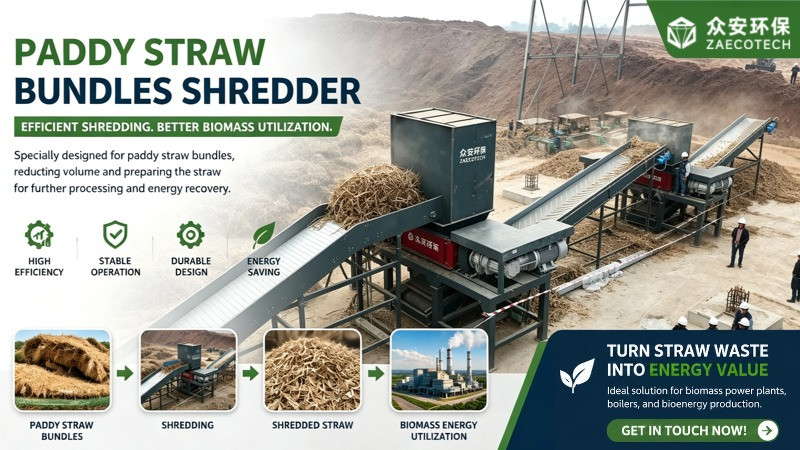
A paddy straw bundles shredder provides an effective solution for reducing the size of baled straw and preparing it for biomass fuel production, power generation, pellet manufacturing, and other renewable energy applications. By integrating high-torque shredding technology with efficient feeding systems, biomass shredders help convert agricultural waste into valuable energy resources.
Although paddy straw has great potential as a biomass resource, its physical characteristics create challenges during industrial processing.
Paddy straw is usually collected and compressed into large bundles or bales for transportation and storage.
However, these bundles often have:
Large dimensions
Low bulk density
Long and tangled fibers
Irregular feeding characteristics
Without proper size reduction, it can be difficult to achieve stable feeding into biomass boilers or fuel preparation systems.
Compared with wood chips or other uniform biomass materials, straw bundles are lighter and more flexible.
Common problems include:
Material bridging
Uneven feeding
Fiber wrapping
Unstable processing capacity
A suitable paddy straw bundles shredder needs sufficient torque and a reliable feeding structure to handle these fibrous materials continuously.
Many biomass applications require relatively uniform feedstock.
Proper shredding helps:
Improve combustion stability
Enhance material handling
Support pellet production
Improve downstream processing efficiency
Shredding is therefore an important preparation stage before biomass utilization.
A biomass shredding system typically follows this process:
Paddy Straw Bundles
↓
Feeding System
↓
High-Torque Shredding
↓
Size Reduction
↓
Biomass Fuel Preparation
Large straw bundles are delivered into the shredder through a suitable feeding system.
For industrial projects, automated feeding reduces manual handling and improves continuous operation.
Unlike high-speed crushing equipment, biomass shredders usually use low-speed and high-torque cutting technology.
The cutting system applies:
Shearing force
Tearing force
Compression force
to break down long straw fibers and reduce material size.
This working principle is suitable for fibrous agricultural residues such as paddy straw, wheat straw, corn stalks, and other biomass materials.
The final shredded material size depends on:
Blade configuration
Screen design
Processing requirements
Different applications may require different output sizes for combustion, pelletizing, or further processing.
After shredding, paddy straw can be used in multiple biomass applications.
Shredded straw can be used as fuel for biomass boilers and power generation systems.
Benefits include:
Stable fuel feeding
Improved combustion performance
Better utilization of agricultural waste
Paddy straw is also a potential raw material for biomass pellets.
Before pelletizing, straw usually requires:
Size reduction
Moisture control
Further processing
A stable shredded feedstock improves the efficiency of pellet production systems.
Processed biomass can also be used as an alternative fuel source in industrial applications.
For example:
Cement plants
Waste-to-energy facilities
Industrial boilers
can utilize prepared biomass fuel to reduce dependence on traditional fossil fuels.
A successful biomass shredding project demonstrates how agricultural residues can be transformed into renewable energy resources.
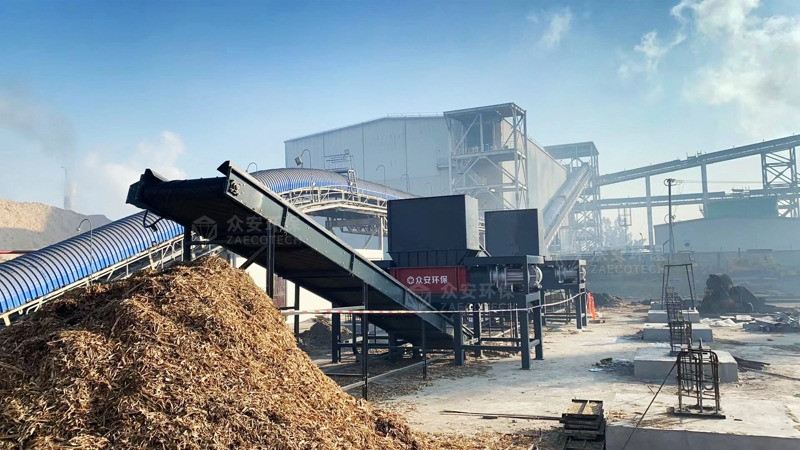
Location: South Asia
Material: Agricultural biomass residues
Application: Biomass fuel preparation for power plants
The project was designed to provide a reliable preprocessing solution for biomass materials, helping improve feeding stability and fuel preparation efficiency.
The system provides:
Stable biomass processing
Reduced manual handling
Improved fuel consistency
Better utilization of agricultural residues
By converting agricultural waste into usable fuel, biomass shredding systems support cleaner energy production and resource recycling.
Selecting the right shredder depends on the actual project requirements.
Consider:
Bundle size
Moisture content
Fiber length
Material density
The equipment should match the biomass supply volume and downstream fuel demand.
Large biomass plants usually require continuous high-capacity shredding systems.
The required output size depends on the next processing stage.
For example:
Power generation may require stable fuel feeding
Pellet production may require smaller particle sizes
Further processing may need customized output
For large-scale projects, the shredder is often integrated with:
Feeding conveyors
Storage systems
Conveying equipment
Screening systems
Control systems
A complete solution improves overall reliability and operating efficiency.
Paddy straw is a valuable renewable resource, but its bulky and fibrous characteristics make industrial processing challenging.
A paddy straw bundles shredder helps transform large straw bales into suitable biomass feedstock for power generation, pellet production, and alternative fuel applications.
By combining efficient feeding, high-torque shredding, and customized system design, biomass shredding technology provides an effective way to convert agricultural waste into renewable energy resources.
The process can be summarized as:
Paddy Straw Bundles → Shredding → Size Reduction → Biomass Fuel → Energy Production
Through efficient biomass utilization, agricultural residues can become a valuable resource instead of waste.


 中文


