

Managing oversized solid waste—such as spring mattresses, upholstered sofas, solid wood furniture, industrial packaging pallets, large plastic drums, and demolition timbers—presents severe mechanical challenges for transfer stations, municipal recovery centers, and fuel preparation plants. Bulky waste exhibits irregular dimensions, inconsistent bulk densities, and abrasive composite assemblies. High-tensile spring steel coils, interwoven textile fabrics, elastic sponge foam, and dense structural timber place intense demands on size-reduction machinery.
In conventional or undersized processing setups, two primary operational bottlenecks regularly halt production: catastrophic material jamming caused by wrapped mattress wires, and accelerated blade wear resulting from high-friction abrasive contact. Knowing how to choose a heavy-duty bulky waste shredder to prevent jamming and blade wear is crucial for plant operators, engineering procurement contractors (EPC), and waste management authorities seeking continuous throughput, low maintenance overhead, and rapid capital payback. This engineering guide details the machine configurations, drive architectures, anti-wrapping tool profiles, cutter metallurgy, and plant safety systems required to maintain high uptime in commercial bulky waste shredder operations.
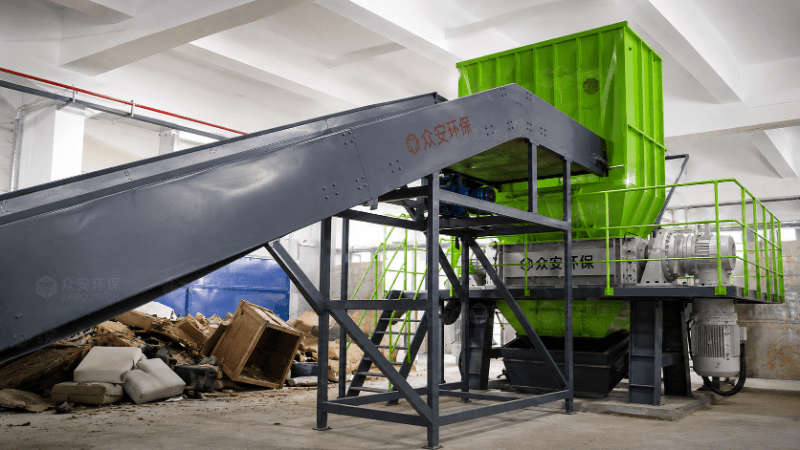
Unlike homogeneous commercial packaging or uniform industrial offcuts, bulky waste contains unpredictable combinations of elastic, tensile, ductile, and abrasive materials. Selecting the right shredding platform requires analyzing the distinct mechanical behaviors of each fraction:
Spring Steel Mattresses & Upholstered Sofas: Contain hundreds of high-tensile continuous pocket coils, border wires, and thick textile covers. Long steel wire cords easily wrap around unprotected cylindrical shafts, binding bearing clearances, puncturing seals, and stalling drivetrains within minutes.
Engineered & Hardwood Furniture: Particle boards (MDF), solid oak frames, and wood shipping pallets introduce heavy structural resistance and abrasive resin binders that require high shear force rather than high speed to fracture cleanly without generating explosive fine dust clouds.
Elastomeric Foam & Multi-Layer Fabrics: Polyurethane sponge and synthetic leather flex under compression. Blunt cutting edges fail to sever flexible polymers cleanly, leading to material dragging between rotor blades and stationary side combs, causing localized overheating and drive stalling.
Concealed Hardware & Foreign Inerts: Cast iron frame brackets, hardened steel fasteners, hinges, concrete fragments, and construction stones create severe impact shock loads that can chip or shatter brittle tool steels.
Continuous operation when processing wire-laden bulky waste depends on mechanical design elements that eliminate shaft entanglement points and manage sudden instantaneous peak loads.
For bulky items, high-speed single-shaft hammer mills or granulators are unsuitable; their high rotational velocities wrap mattress steel into tight coils and generate excessive thermal friction. A heavy-duty double-shaft bulky waste shredder operating at 10 to 20 RPM provides positive draw-down. Counter-rotating shafts equipped with aggressive hooked cutting discs puncture, slice, and rip bulky furniture downward through opposing knife faces with open-bottom gravity discharge.
The definitive engineering solution against wire binding is the implementation of precision-machined stationary clearing combs (counter-knives) mounted beneath the cutting discs:
Inter-Disc Scrapers: Heavy-gauge alloy steel scrapers extend directly between adjacent rotary discs down to the shaft core.
Continuous Wire Stripping: As cutting discs rotate, the stationary combs strip elongated textiles, mattress springs, and plastic strapping out of the blade gaps, preventing wires from coiling around the rotor axis.
Bulky waste processing requires high torque and smart load management:
Dual Independent Drivetrains: Driving each hexagonal shaft with its own planetary gearbox and high-torque electric motor allows differential speed operation, which prevents bulky hollow items (such as armchairs and plastic tanks) from bridging or riding atop the rotors.
Millisecond Overload Reversal: High-sensitivity current transformers (or hydraulic pressure sensors) monitor drive loads continuously. When an uncrushable solid steel axle or thick structural iron bracket creates an instantaneous torque spike, the automated PLC halts rotor rotation within milliseconds, reverses shaft direction to release and reposition the blockage, and then resumes forward cutting. If the solid obstruction persists after preset cycles, the shredder safely shuts down and sounds an alarm.
Cutting tool replacement and maintenance represent the highest ongoing operational expenditure (OPEX) in solid waste shredding facilities. Maximizing blade lifespan against abrasive wood and high-tensile wire requires balancing surface hardness with internal fracture toughness.
Basic structural steels or low-alloy carbons wear down rapidly under the abrasive silica content of wood and the repetitive impact of metal springs. Industrial cutting tools must utilize premium tool steels:
Forged D2 / 1.2379 / Cr12MoV: High-carbon, high-chromium tool steels vacuum heat-treated to 54–57 HRC offer exceptional wear resistance while maintaining sufficient core elasticity to resist brittle fracture when striking foreign metal hardware.
Specialized High-Nickel Shock Alloys: For operations dominated by heavy automotive scrap and thick metal-reinforced furniture, high-nickel impact alloys deliver superior impact resistance against catastrophic tooth chipping.
Blade profile directly dictates energy consumption and cutting efficiency:
Single-Claw vs. Multi-Claw Discs: Single-hook discs deliver massive point penetration to grab and crush hollow wooden furniture, while multi-claw profiles provide multiple cuts per revolution, smoothing motor load profiles and producing a tighter, more uniform output strip.
Chamfered Edge Cutting Faces: Precision CNC-milled cutting disc faces maintain sharp scissor-action clearances (0.5 mm to 1.5 mm) against opposing discs, slicing fabric covers and mattress foam cleanly rather than tearing and pinching them.
To avoid costly complete shaft disassembly and prolonged plant shutdowns, select cutting discs that support on-site maintenance. Many commercial designs feature weldable alloy substrates that allow maintenance teams to rebuild worn cutting hooks and side edges using specialized hardfacing welding alloys directly inside the cutting chamber during scheduled downtime.
Abrasive particle wear affects the cutting chamber housing, bearing seats, and side frames as well as the blades. Heavy-duty structural protection is essential for long-term machine integrity:
| Shredder Subsystem | Standard Waste Shredder Design | Heavy-Duty Bulky Waste Shredder Specification |
|---|---|---|
| Cutting Chamber Sidewalls | Bare mild carbon steel (Q235 / A36) | Fully lined with bolted, replaceable Hardox 500 / Hardox 600 wear plates |
| Rotor Shafts | Standard keyed round carbon steel shafts | Integral forged 42CrMo hexagonal or multi-splined shafts for 360° torque distribution |
| Shaft Seal Protection | Single elastomeric lip seals | Multi-stage labyrinth seals with sacrificial bronze wear rings and grease-purge barriers |
| Bearing Assembly Mounting | Internal flanged housings within chamber walls | External outboard spherical roller bearings isolated from cutting debris and moisture |
| Hopper Feed Geometry | Straight vertical walls prone to bridging | Flared high-capacity hopper with hydraulic hold-down / tilting press arms |
A high-throughput municipal or commercial bulky waste shredding plant transforms raw, unwieldy discards into segregated, high-value commodity streams through an automated, multi-stage processing layout:
Stage 1: Bulk Infeed & Hydraulic Assist: A wide steel plate apron conveyor or heavy-duty crane grapple feeds mattresses and furniture into an oversized hopper. A hydraulic tilting ram or articulating hold-down arm pushes voluminous items directly into the cutting zone, eliminating bridging.
Stage 2: Primary High-Torque Shearing: The heavy-duty bulky waste shredder shears timber frames, mattress springs, and upholstery into uniform 100 mm to 250 mm chunks, completely untangling and liberating embedded metal components.
Stage 3: High-Gradient Ferrous Metal Extraction: The shredded stream discharges onto a high-speed accelerator conveyor. An inline or cross-belt self-cleaning overband magnetic separator continuously extracts up to 98% of liberated spring steel coils, mattress wires, screws, and brackets, generating high-density scrap metal for secondary steelmaking.
Stage 4: Density & Aerodynamic Classification (Air Windshifter): A high-velocity air drum classifier separates light, high-calorific foam and textile fluff from heavy wooden blocks, directing clean biomass wood toward boiler fuels or particleboard plants and sending light fractions to secondary RDF lines.
Stage 5: High-Performance Baling & Logistics: Separated polyurethane foam, liberated spring metal, and clean wood chips are directed to automatic horizontal balers or open bulk containers, slashing hauling volume by up to 70% to 80% and drastically reducing transfer logistics costs.
Processing dry wood furniture, synthetic textiles, and spring steel produces mechanical sparks and fine combustible particulates that require dedicated safety engineering:
Automated Micro-Fog Water Mist Suppression: Shredder hoppers and discharge chutes should feature integrated infrared (IR) optical spark sensors paired with high-pressure atomizing water fog nozzles. These extinguish friction sparks instantly without soaking wood or saturating textile streams.
Negative-Pressure Dust Ventilation: Enclosing the shredder discharge hood and ducting it to a centralized pulse-jet fabric baghouse maintains negative pressure, capturing airborne wood dust and textile lint to comply with strict OSHA and ATEX safety standards.
External Outboard Bearing Housings: Mounting heavy-duty spherical roller bearings in split plummer blocks completely separated from the shredder chassis prevents wood flour, fiber lint, and wire strands from penetrating bearing seals, preventing premature bearing failure.
Maximizing facility throughput and profitability when processing voluminous municipal scrap requires moving beyond standard multi-purpose shredders. Selecting an industrial heavy-duty bulky waste shredder engineered with low-speed, high-torque twin-shaft shearing, integrated stationary clearing combs, forged D2 vacuum-hardened cutting discs, bolted Hardox wear liners, and automated PLC overload reverse controls eliminates wire wrapping and curbs tool wear. This purpose-built approach transforms unwieldy mattresses, sofas, and timber into high-purity scrap metal, premium biomass fuel, and densified refuse-derived fuels, keeping recycling plants running efficiently with minimum downtime.


 中文


