

The global plastics conversion and reclamation industry is undergoing a structural transformation. Driven by international circular economy targets, extended producer responsibility (EPR) regulations, and increasing brand commitments to high recycled content percentages, post-industrial and post-consumer plastic scrap has shifted from a low-value byproduct to a critical secondary commodity. However, processing plastic scrap presents distinct operational challenges due to extreme polymer diversity, varied physical geometries, high contamination risks, and differing thermal properties.
To convert heterogeneous scrap into high-purity flakes and regrind, recyclers and plant operators deploy specialized size reduction, washing, and separation equipment. Investing in the correct industrial plastic recycling machines is essential to maintain high throughput, prevent thermal polymer degradation, protect tool life, and maximize return on investment (ROI). This comprehensive guide provides an engineering analysis of industrial plastic recycling machine types, working principles, polymer-specific machinery selection, and plant sizing methodologies.
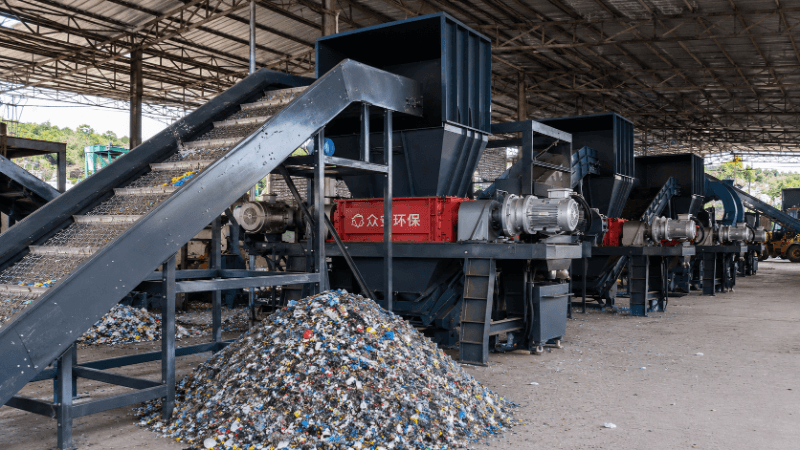
Industrial plastic scrap encompasses a broad spectrum of polymers, each exhibiting distinct shear resistance, tensile strength, melt flow characteristics, and bulk densities. Machinery configurations must match these specific physical properties:
Rigid Polymers (High Tensile / Brittle): Thick-walled high-density polyethylene (HDPE) containers, polypropylene (PP) battery cases and crates, acrylonitrile butadiene styrene (ABS) electronic housings, and polyvinyl chloride (PVC) pipe profiles. These materials require high-torque, low-speed shearing to fracture thick wall cross-sections without stalling the drive.
Flexible Films & Fibrous Polymers (High Elasticity / Low Bulk Density): Linear low-density polyethylene (LLDPE) agricultural and stretch films, low-density polyethylene (LDPE) shrink wrap, woven PP jumbo bags (FIBCs), and non-woven synthetic fibers. These elastic polymers require sharp scissor-action cutting to prevent flexible strands from wrapping around shafts or binding rotor clearances.
High-Molecular-Weight Engineering Purging & Solid Lumps: Massive injection molding solid lumps, start-up extruder purgings, and thick extruded polymer sheets. These high-mass solid blocks generate extreme resistance, requiring high-inertia single-shaft rotors driven by load-sensing hydraulic pusher rams.
Hollow Containers & Bulky Scrap: Intermediate bulk containers (IBC totes), 200-liter chemical drums, automotive fuel tanks, and large waste bins. These bulky parts require aggressive counter-rotating cutter designs to draw high-volume parts directly into the cutting zone without pre-cutting.
A continuous plastic reclamation plant integrates an automated sequence of size reduction, washing, density separation, and mechanical drying equipment.
The standard platform for heavy purgings, solid lumps, dense thick-walled plastics, and baled materials. A heavy-duty single-shaft plastic shredder utilizes a large-diameter rotor fitted with concave, indexable square cutter inserts rotating opposite an adjustable stationary bed knife, assisted by a horizontal load-sensing hydraulic ram.
Working Principle: The hydraulic ram forces the bulk plastic against the rotating cutter drum (60–100 RPM). Material is sheared progressively through scissor action and discharged through an interchangeable sizing screen basket (typically 30 mm to 60 mm mesh) located underneath the rotor.
Primary Target Feedstock: Solid extruder purgings, thick injection lumps, dense PP/HDPE crates, and baled agricultural plastics.
The core machine for high-volume primary coarse reduction of hollow, voluminous, and elastic plastic waste. A twin-shaft plastic shredder features two parallel, intermeshing counter-rotating shafts equipped with hooked alloy cutting discs.
Working Principle: Operating at low rotational velocities (10–25 RPM), the high-torque hooked discs grip hollow containers, pulling them directly into the cutting zone where they are sheared, ripped, and flattened by opposing knife faces with open-bottom gravity discharge.
Primary Target Feedstock: 1,000-liter IBC totes, 200-liter blue chemical drums, hollow blow-molded containers, car bumpers, and tangled plastic netting.
Designed to deliver calibrated fine regrind for direct extrusion or compounding injection. A heavy-duty plastic granulator operates at high rotational speeds (450–650 RPM), utilizing rotary knife flywheels matched against stationary bed knives.
Working Principle: Precision shearing blades slice pre-shredded flakes into clean, uniform regrind (typically 6 mm to 12 mm) over a bottom screen basket. Granulators can be configured for dry grinding or wet grinding (with continuous water injection to wash dirt and cool cutting edges).
Primary Target Feedstock: Secondary refining of pre-shredded flakes, direct reduction of blow-molded bottles, runners, sprues, and thin-gauge sheet offcuts.
Purifying shredded flakes of dirt, oil, and cross-polymer contamination is vital for market-grade regrind:
High-Speed Friction Washer: A high-velocity paddle rotor (800–1,200 RPM) spins plastic flakes within an abrasive mesh screen drum under continuous pressurized water spray, scouring paper labels, adhesives, and surface dirt.
Hydrodynamic Sink-Float Density Tank: Exploits specific gravity differences in water ($\rho = 1.0\text{ g/cm}^3$). Polyolefin flakes (PP and PE, density < 1.0) float on the surface and are skimmed off, while dense contaminants (PVC, PET, dirt, metals, density > 1.0) sink to the bottom for continuous auger discharge.
Extruder feeds require strict moisture control (< 1%). Centrifugal mechanical dewatering dryers spin at high speeds to strip up to 98% of surface moisture through an external screen cage, followed by hot-air pipe drying systems and zig-zag de-dusters to eliminate fines and airborne micro-particles.
The table below summarizes mechanical characteristics, operating parameters, and processing roles across standard industrial plastic recycling equipment:
| Equipment Platform | Rotor Operating Speed | Drivetrain Architecture | Screen Sizing Control | Primary Industrial Role |
|---|---|---|---|---|
| Single-Shaft Shredder | 60–100 RPM | Electric motor with heavy flywheel / Hydraulic | Yes (Interchangeable screen: 30–60 mm) | Primary & secondary reduction of solid lumps, purgings, and dense crates |
| Double-Shaft Shredder | 10–25 RPM | Dual independent planetary gearboxes / Hydraulic | No (Open gravity discharge) | Primary high-volume coarse shearing of hollow IBC totes, drums, and films |
| High-Speed Granulator | 450–650 RPM | High-speed belt drive with heavy flywheel | Yes (Interchangeable screen: 6–12 mm) | Fine grinding to produce uniform flake regrind for direct extrusion |
| High-Speed Friction Washer | 800–1,200 RPM | Direct high-speed motor drive | Perforated dewatering screen cage | High-intensity mechanical scouring to remove surface glue, dirt, and labels |
| Sink-Float Density Tank | Continuous mechanical paddles | Low-speed gear motor drives | Not applicable (Liquid medium) | Density-based splitting of polyolefins (PE/PP) from dense polymers (PVC/PET) |
Selecting the correct machinery sizing requires calculating continuous mass flow rates, feed dimensions, cutting chamber geometry, and power consumption.
The cutting chamber opening must be sized larger than the maximum dimensions of the largest un-shredded item to prevent bridging:
For 1,000L IBC Totes and Heavy Drums: Chamber width must be at least 1,400 mm to 1,800 mm with aggressive dual-shaft hooked cutting discs to pull voluminous items down without pre-crushing.
For Heavy Purging Blocks (Up to 500 kg): Single-shaft shredder cutting chambers require high-tensile reinforced ram guide rails and hydraulic cooling systems to withstand continuous lateral thrust loads.
Torque is the decisive factor for heavy-duty plastic size reduction. Sizing drive power ($\text{kW}$) must account for instantaneous shear resistance:
Standard Granulation / Thin Plastics: 1.5 to 2.5 kW of drive power per 100 kg/hour of target throughput.
High-Torque Single/Double-Shaft Shredding (Solid Purgings / Dense HDPE): 4.0 to 6.5 kW of drive power per 100 kg/hour of target throughput to prevent motor stalling during peak impact loading.
Recycled plastic scrap often contains abrasive mineral fillers ($\text{CaCO}_3$, talc), glass fiber reinforcements, and dirt. Selecting proper tool steels ensures extended operational life:
D2 / 1.2379 / Cr12MoV: High-carbon, high-chromium tool steels vacuum heat-treated to 56–58 HRC provide the industry benchmark for general plastic shearing.
DC53 / High-Vanadium Alloys: For reinforced engineering plastics (such as 30% glass-fiber-filled polyamide/PA66), premium alloy knives heat-treated to 60–62 HRC prevent premature edge wear.
Hardox 500 Chamber Liners: Bolted, replaceable abrasion-resistant steel liners inside cutting chambers protect the primary chassis from abrasive scouring.
A modern commercial plant operating at 1,000 to 3,000 kg/hour integrates individual machines into an automated, continuous operational flow:
Stage 1: Primary Shredding: A double-shaft shredder or single-shaft shredder reduces bulk scrap, drums, or bales down to 40–80 mm chunks.
Stage 2: Ferrous & Non-Ferrous Separation: Overband permanent magnets extract steel screws, wire, and tramp metal inserts to protect downstream granulator knives.
Stage 3: Wet Fine Granulation: A wet granulator reduces chunks into uniform 8–12 mm flakes while injecting water to initiate washing and cool cutting edges.
Stage 4: High-Speed Friction Scouring: A friction washer strips remaining labels, adhesive residue, and dirt.
Stage 5: Hydrodynamic Sink-Float Separation: The sink-float tank separates clean polyolefins (PE/PP) from dense polymers (PET/PVC) and sinks residual mineral grit.
Stage 6: Mechanical Centrifugal Drying: A high-velocity spin dryer removes surface moisture, followed by an inline hot-air pipe drying circuit, delivering clean, dry flakes (< 1% moisture) ready for direct compounding, pelletizing, or packaging.
Operating a high-capacity plastic processing facility requires robust mechanical and electrical protection standards:
Intelligent PLC Overload Protection: Real-time current sensors monitor motor amperage. Upon encountering uncrushable solid metal objects, the automated control system stops rotation within milliseconds and executes a programmed reverse cycle to reposition or safely discharge the obstruction.
External Outboard Bearing Housings: Heavy-duty spherical roller bearings are mounted in heavy cast housings completely isolated from the cutting chamber via multi-stage labyrinth and mechanical face seals, preventing fine plastic dust and wash water ingress.
Hydraulic Maintenance Access: Single-shaft shredders and heavy granulators should be equipped with hydraulic swing-open service doors and slide-out screen cradles to simplify knife rotation and screen changes.
Maximizing profitability in the modern recycling sector requires moving away from generic size-reduction machinery toward purpose-built processing lines. Investing in high-performance industrial plastic recycling machines—including low-speed high-torque shredders, high-speed granulators, friction washers, and hydrodynamic separation tanks—ensures high material recovery, consistent regrind purity, and low operational downtime. By properly sizing drive powertrains, matching cutter metallurgy to specific polymer properties, and establishing automated sorting workflows, operators transform complex plastic waste into high-grade secondary raw materials that meet strict industrial manufacturing standards.


 中文


