
As first- and second-generation utility-scale wind farms reach the end of their 20-to-25-year operational lifespans, decommissioning contractors and industrial recycling facilities face a rapidly escalating material challenge: processing tens of thousands of tons of retired wind turbine rotor blades. Engineered to withstand extreme aerodynamic bending loads and decades of harsh weather, modern wind blades are complex thermoset composite structures composed of multi-axial Glass Fiber Reinforced Polymer (GFRP) skins, structural epoxy or polyester resins, balsa wood or PVC structural foam cores, and carbon fiber spar caps. While mechanical size reduction is the essential gateway to cement kiln co-processing, pyrolysis, and composite filler recovery, standard crushing systems rapidly fail when confronted with the relentless abrasiveness and airborne particulate hazards inherent to fiberglass composites.
When conventional impact crushers, hammer mills, or standard municipal waste shredders process wind blade sections, microscopic glass filaments scour cutting edges away within hours, driving up motor amperage and forcing costly maintenance shutdowns. Simultaneously, high-speed mechanical pulverization generates dense clouds of respirable glass needles and electrically conductive carbon fiber dust—posing severe occupational respiratory risks, explosion hazards, and immediate short-circuit threats to unprotected electrical control panels. Deploying purpose-built anti-abrasion wind blade shredding systems—engineered with vacuum-hardened high-chromium alloy cutters, bolt-on Hardox 500 chamber armoring, low-speed scissor-shear kinematics, negative-pressure HEPA pulse-jet filtration, and IP65-sealed electrical isolation—enables recycling plants to conquer both rapid cutter wear and hazardous composite dust. This technical guide examines composite silica abrasion mechanics, wear-resistant metallurgy, dust containment engineering, and closed-loop plant integration for end-of-life wind rotor recycling plants.
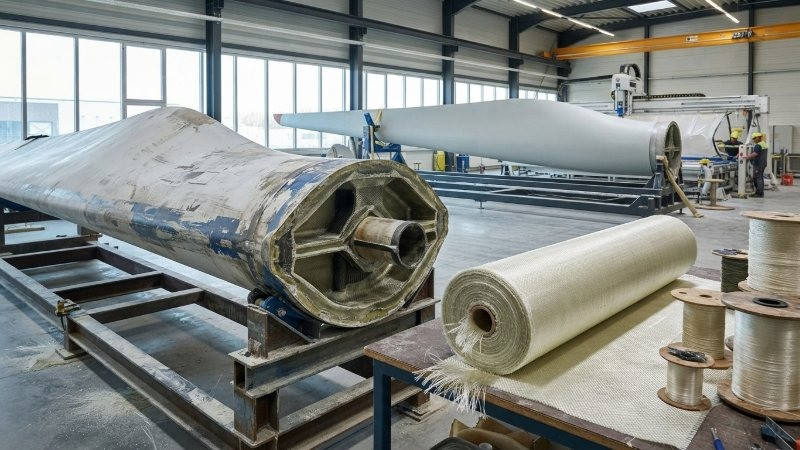
To design a continuous, compliant size-reduction line for decommissioned GFRP and CFRP wind blades, plant engineers must neutralize two interconnected physical hazards:
Relentless Silica Scouring and Rapid Edge Rounding: E-glass and high-modulus S-glass fibers are composed primarily of amorphous silica with a Mohs hardness approaching 6.5—harder than standard unhardened carbon steels. During size reduction, millions of fractured glass filaments act like high-pressure grinding grit, rapidly rounding off cutter tips, widening scissor clearances, and forcing the machine to tear rather than slice tough epoxy laminates.
Frictional Heat and Thermoset Resin Glazing: As dull blades rub against thick fiberglass root rings and structural adhesive joints, localized frictional temperatures spike above 180 degrees Celsius. This thermal buildup softens epoxy and polyurethane bonding pastes into gummy residues that coat rotor spacers, blind discharge screens, and accelerate thermal softening of cutter edges.
Respirable Glass Micro-Needles and Dermal Irritation: High-speed kinetic impact shatters glass fibers into airborne fragments below 5 microns in diameter. Without source-point negative-pressure capture, these microscopic glass needles remain suspended in the plant atmosphere, causing severe skin irritation, eye damage, and chronic respiratory hazards for plant operators.
Electrically Conductive Carbon Fiber Dust Shorts: Modern 50-to-85-meter blades integrate unidirectional Carbon Fiber Reinforced Polymer (CFRP) spar caps for stiffness. When sheared or granulated, liberated carbon micro-fibers float onto circuit boards, variable-frequency drives (VFDs), and motor terminal blocks—bridging electrical contacts and triggering catastrophic short circuits and control cabinet fires.
Extending cutter service intervals across multi-shift wind blade processing requires combining low-speed shearing kinematics with extreme metallurgical surface hardness and replaceable structural armoring:
Rather than pulverizing composite laminates through high-speed kinetic impact—which maximizes both abrasive sliding velocity and fine dust generation—purpose-built primary and secondary wind blade shredders operate at intentionally low rotational speeds (10 to 18 RPM for twin-shaft primary shredders; 55 to 85 RPM for single-shaft fine shredders). Driven by oversized planetary gearboxes, counter-rotating cutting disks execute a clean, low-velocity scissor-shear cut through thick fiberglass walls, drastically reducing sliding friction and keeping fine dust generation to a minimum.
To resist continuous silica and carbon fiber scouring without chipping under heavy structural root loads, primary cutting disks and secondary rotor knives are forged from premium high-carbon, high-chromium cold-work tool steels (such as D2, DC53, or specialized NiCrMo alloys) and vacuum heat-treated to 56–60 HRC. On secondary fine shredders, four-way indexable concave square cutters allow maintenance crews to rotate worn cutting edges 90 degrees four times before workshop regrinding—quadrupling tool life while maintaining tight 0.4 mm to 0.8 mm micro-gap shearing clearances.
Abrasive glass fibers do not just wear down cutting edges; they also erode hopper sidewalls, hydraulic pusher faceplates, and discharge chutes. Heavy-duty wind blade shredders feature fully bolt-on, replaceable Hardox 500 wear liner plates across all high-contact internal zones, protecting the structural frame and allowing rapid liner swaps during scheduled maintenance.
Microscopic glass dust is lethal to rolling-element bearings. To guarantee bearing longevity, heavy-duty spherical roller bearings are mounted externally in split plummer blocks—completely separated from the cutting chamber by open atmospheric air gaps and multi-stage, grease-purged labyrinth seals that physically block abrasive composite dust from reaching bearing races.
Protecting worker health and preventing conductive carbon dust short circuits requires a fully enclosed, negative-pressure aerodynamic containment system integrated directly into the shredding line:
Fully Enclosed Hoods and Negative-Pressure Capture: Both primary and secondary shredders—along with all transfer conveyor drop points—are enclosed within sealed sheet-metal hoods connected via balanced ductwork to a high-static-pressure pulse-jet baghouse dust collector. Maintaining continuous negative pressure inside the cutting zone ensures air flows inward through every feed portal, preventing glass and carbon fibers from escaping into the facility.
PTFE-Membrane Cartridge Filtration and HEPA Polishing: Standard felt filter bags rapidly blind when exposed to needle-like glass fibers. Composite dust collectors utilize pleated, PTFE-membrane-coated filter cartridges that capture 99.9 percent of sub-micron particulates on the outer surface for clean pulse-jet release, followed by secondary HEPA safety filters where air is recirculated indoors.
Infrared Spark Detection and Explosion Venting: Because fine epoxy resin dust and balsa wood core particles form combustible dust clouds, extraction ducts are equipped with high-speed infrared spark detectors linked to automated water-mist suppression nozzles, while baghouse housings feature certified explosion venting panels.
IP65/IP66 Dust-Tight Electrical Enclosures: To eliminate conductive carbon dust short circuits, all PLC control cabinets, VFD enclosures, junction boxes, and motor terminal housings are built to strict IP65/IP66 ingress protection standards and pressurized with filtered clean air—isolating sensitive electronics completely from the ambient composite processing environment.
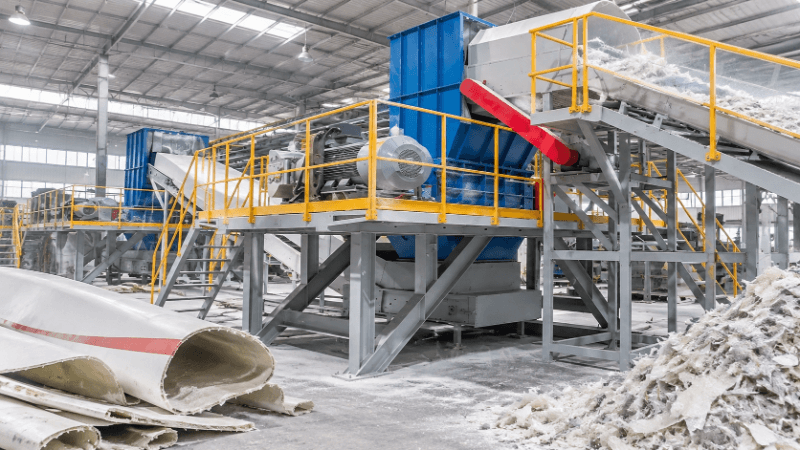
The table below summarizes cutter wear life, airborne dust control, electrical protection, and root-section shearing capability across conventional waste crushers versus specialized anti-abrasion wind blade shredders:
| Operational & Safety Metric | Conventional Impact Crushers / Waste Shredders | Anti-Abrasion Wind Blade Shredders |
|---|---|---|
| Cutter Wear Life on Fiberglass | Standard steel edges round off within hours under relentless silica fiber abrasion. | Vacuum-Hardened High-Alloy Cutters (56–60 HRC) extend service life by over 300%. |
| Glass & Carbon Dust Containment | Open hoppers and high-speed pulverization release hazardous airborne micro-fibers. | Low-Speed Shearing & Negative-Pressure PTFE Baghouses capture 99.9% of dust at the source. |
| Conductive Carbon Dust Protection | Standard ventilated control panels suffer frequent short circuits from airborne CFRP dust. | IP65/IP66 Pressurized Electrical Cabinets prevent conductive fiber ingress completely. |
| Thick Root Ring & Bolt Tolerance | Rotors stall on 100 mm+ root walls; embedded steel T-bolts shatter brittle hammers. | Planetary High-Torque Drives & PLC Auto-Reversal shear thick laminates and protect tools. |
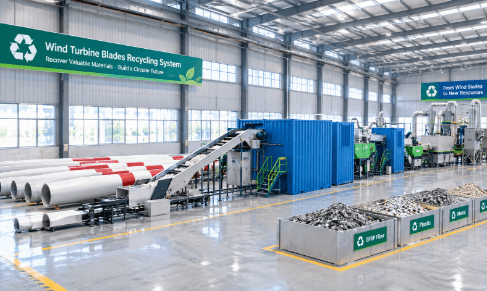
A modern, high-availability wind turbine blade recycling line integrates anti-abrasion size reduction with automated dust extraction and multi-stage separation:
Stage 1: Pre-Sectioned Blade Feeding and Enclosed Primary Shearing: Wind blade segments (pre-cut onsite via diamond wire saws into 3-to-6-meter sections) are loaded via grapple crane into the enclosed high-torque twin
How to Choose a Wind Turbine Blade Shredder to Maximize Blade Life and Lower Maintenance Costs
Unlocking the Value of Wind Blade Recycling: Recovering Fibers and Resins for Profit

How Are Wind Turbine Blades Typically Disposed Of?
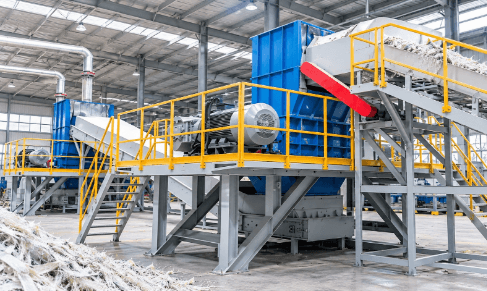
Heavy-Duty Size Reduction for Oversized Wind Turbine Rotor Blades and Carbon Fiber Composites in Spain


 中文


