
Spain stands as one of Europe’s premier pioneers in renewable wind energy infrastructure, with vast wind farms operating across Castile and León, Aragon, Galicia, and Andalusia since the late 1990s and early 2000s. As this first generation of onshore turbines reaches the end of its operational lifecycle—and as Spanish energy operators accelerate repowering initiatives to install higher-capacity modern turbines—the nation faces an urgent industrial waste management challenge: decommissioning and recycling tens of thousands of tons of massive wind turbine rotor blades. Constructed from thick, multi-layered Glass Fiber Reinforced Polymers (GFRP) and ultra-high-strength Carbon Fiber Reinforced Polymers (CFRP) bonded to balsa wood and structural PVC foam cores, retired rotor blades cannot be melted down like thermoplastics and are strictly barred from conventional landfill disposal under tightening European Union and Spanish circular economy mandates.
Transforming 40-to-80-meter monolithic composite blades into uniform, high-value fractions suitable for Spanish cement kiln co-processing, thermal pyrolysis, or mechanical composite recycling demands extreme mechanical force and specialized wear engineering. Conventional high-speed crushers and standard municipal waste shredders suffer immediate mechanical failure when processing thick blade root sections and carbon fiber spars, experiencing rapid edge dulling, severe rotor jams, and hazardous airborne particulate emissions. Deploying purpose-built heavy-duty wind turbine blade shredders—engineered with low-speed high-torque twin-shaft kinematics, independent planetary gearboxes, vacuum-hardened alloy cutting tools, and integrated negative-pressure dust containment—enables Spanish waste management operators and composite recycling hubs to process oversized rotor blades safely and continuously. This technical guide examines composite blade rheology, high-torque shearing mechanics, carbon fiber cutting challenges, and integrated plant layouts for optimizing wind turbine blade recycling in Spain.
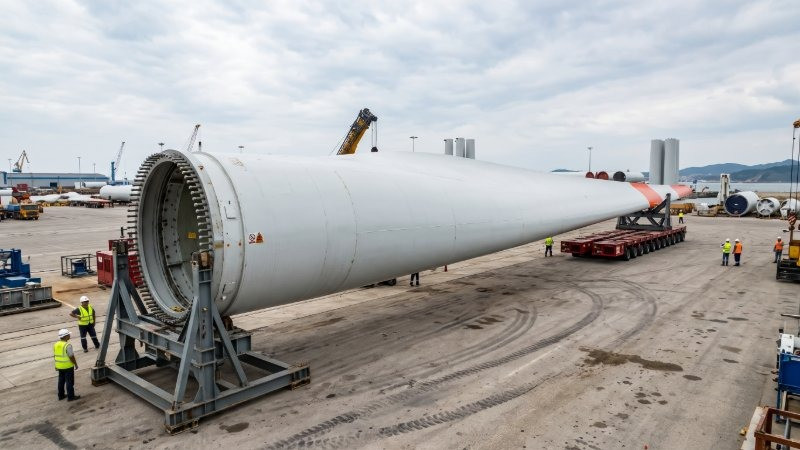
To engineer an effective size-reduction line for decommissioned wind blades in Spain, facility operators must address the extreme structural characteristics designed to keep blades intact during decades of severe atmospheric stress:
Ultra-Thick Glass and Carbon Fiber Laminates: While outer aerodynamic shells consist of multi-axial fiberglass layers, modern and large-scale rotor blades incorporate thick carbon fiber spar caps and massive cylindrical root sections exceeding 100 mm in solid composite thickness. Fracturing these dense laminates requires immense, sustained shearing torque.
Severe Silica and Carbon Abrasion: Glass filaments are essentially microscopic shards of silica, while carbon fibers possess extreme hardness and electrical conductivity. During mechanical size reduction, these fibers act as an aggressive abrasive paste that rapidly scours standard carbon steel blades, while conductive carbon dust poses short-circuit risks to unprotected electrical enclosures.
Elastic Structural Cores and Resin Matrices: Cross-linked thermoset epoxy and polyester resins bind the reinforcing fibers to lightweight balsa wood or structural foam cores. This hybrid sandwich structure resists brittle fracture, absorbing blunt impact energy and rebounding against conventional hammer mills.
Hazardous Microscopic Dust Generation: Shearing fiberglass and carbon composites releases fine, inhalable micro-fibers and resin particulates. Strict Spanish workplace health regulations and environmental standards require complete enclosure and negative-pressure filtration to protect personnel and prevent environmental contamination.
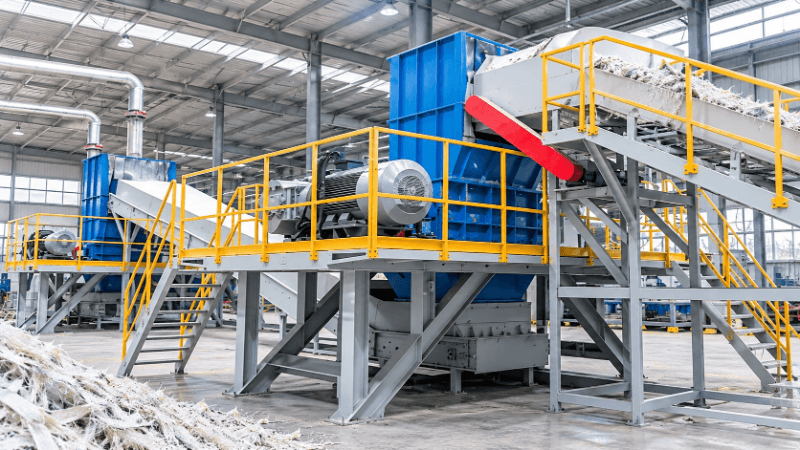
Breaking down thick, abrasive wind turbine rotor sections into manageable, uniform chips requires a synchronized mechanical architecture built around massive force multiplication, precision shearing clearances, and total dust isolation:
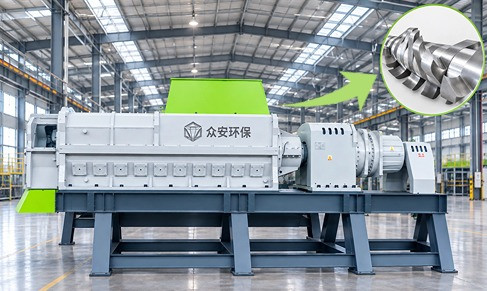
Specialized wind blade shredders utilize two separate, heavy-duty electric or hydraulic drive motors coupled with high-reduction planetary gearboxes. Each hexagonal rotor shaft operates independently, delivering massive, synchronized rotational torque to bite into thick root rings and carbon fiber spars without stalling or tripping overload relays.
Operating at intentionally slow rotational speeds (typically 10 to 18 RPM), the shredder relies entirely on mechanical force multiplication rather than kinetic velocity. This low-speed profile ensures the aggressive hook-shaped cutting disks maintain positive grip on curved, smooth aerodynamic blade shells, pulling them downward into the cutting zone while minimizing frictional heat and airborne dust generation.
To cleanly sever tough, flexible carbon and glass fiber bundles without bending or folding them between rotors, the cutting disks are engineered with tight side-to-side micro-gap tolerances. As the parallel shafts counter-rotate, the intermeshing blades execute a powerful scissor-shear cut that fractures both the rigid thermoset resin and the high-tensile fiber filaments simultaneously.
Decommissioned blades frequently retain heavy steel root bolts, embedded lightning protection copper cables, and structural metal inserts. Equipped with real-time motor amperage monitoring via the central PLC, the machine detects sudden torque spikes within milliseconds, automatically reversing shaft rotation to clear uncrushable metal objects before resuming normal forward operation.
The table below summarizes cutting performance, wear resistance, dust containment, and operational reliability across generic high-speed crushers versus specialized heavy-duty wind blade shredders:
| Performance Metric | Conventional High-Speed Crushers / Mills | Heavy-Duty Wind Turbine Blade Shredders |
|---|---|---|
| Thick Root & CFRP Cutting | Lacks torque to fracture thick laminates; rotors stall and hammers shatter on impact. | Independent Planetary Torque Drives effortlessly shear thick root rings and carbon spars. |
| Abrasive Wear Resistance | Silica and carbon fibers dull standard blades within hours, causing frequent shutdowns. | Vacuum-Hardened High-Alloy Tool Steels resist extreme fiber abrasion for long service life. |
| Dust & Carbon Fiber Safety | Generates dense clouds of hazardous glass/carbon dust, risking respiratory and electrical faults. | Sealed Negative-Pressure Hoods & IP65 Controls contain dust and protect electronics. |
| Embedded Metal Tolerance | Stray steel root bolts and copper lightning rods cause catastrophic internal rotor damage. | Auto-Reversing PLC Logic detects tramp metal instantly and reverses to prevent damage. |
Processing abrasive fiberglass and conductive carbon fiber composites subjects internal cutting assemblies and plant electronics to unique industrial hazards:
Vacuum-Hardened High-Alloy Tool Steels: Cutting disks and stationary counter-blades are forged from premium high-carbon, high-chromium tool steels (such as D2, DC53, or specialized NiCrMo alloys) and vacuum heat-treated to 56–60 HRC. This metallurgical profile provides exceptional resistance against silica scouring while retaining the core toughness required to absorb shock loads.
Hardox 500 Chamber Armoring: Internal cutting chamber sidewalls, hopper impact zones, and discharge chutes are lined with replaceable, bolt-on Hardox 500 wear plates, protecting the primary structural chassis from abrasive composite erosion.
Outboard Bearing Isolations: Heavy-duty spherical roller bearings are housed externally in split plummer blocks, completely separated from the cutting zone by open atmospheric air gaps and multi-stage grease-purged labyrinth seals to prevent microscopic glass and carbon fibers from entering bearing races.
Dust-Tight IP65 Electrical Enclosures: Because carbon fiber dust is electrically conductive, all control cabinets, junction boxes, and motor terminals are sealed to strict IP65/IP66 standards with positive-pressure ventilation, eliminating the risk of short circuits.
A modern wind turbine blade recycling facility in Spain integrates primary mobile field preparation with centralized heavy-duty shredding and downstream material recovery:
Stage 1: Onsite Wind Farm Sectioning: Because 60-meter blades cannot be transported whole on Spanish highways, mobile diamond wire saws or hydraulic shears section the blades directly at the wind farm into manageable 3-to-6-meter transport segments.
Stage 2: Primary High-Torque Shredding: Transported segments are loaded via grapple cranes into the heavy-duty twin-shaft shredder, which reduces thick shells, foam cores, and carbon spars into uniform 100 mm to 200 mm coarse fractions while liberating steel root fasteners.
Stage 3: Magnetic Separation and Secondary Granulation: Coarse shredded composites pass beneath suspended overband magnetic separators to extract ferrous bolts, followed by secondary granulators equipped with calibrated screens to size the material down to 10 mm to 30 mm chips.
Stage 4: Industrial Valorization in Spain: Clean, sized GFRP fractions are delivered to regional Spanish cement kilns for co-processing—where the organic polymer resin provides high-calorific thermal energy and the silica glass fiber acts as a direct mineral substitute for clinker production—while separated CFRP fractions are routed to specialized pyrolysis plants for carbon fiber reclamation.
As Spain leads Europe in wind farm repowering and renewable energy expansion, establishing reliable end-of-life composite processing infrastructure is essential for environmental compliance and resource circularity. Deploying heavy-duty wind turbine blade shredders—engineered with independent dual-motor planetary drivetrains, low-speed high-torque shear kinematics, ultra-hardened alloy tooling, and comprehensive dust and electrical safeguards—overcomes the extreme mechanical and abrasive challenges of GFRP and CFRP rotor blades. This specialized engineering approach ensures continuous operational uptime, protects worker safety, and transforms retired wind turbine blades into valuable industrial feedstocks across Spain.
Textile Waste to RDF Production Line: How to Turn Textile Waste into Alternative Fuel?
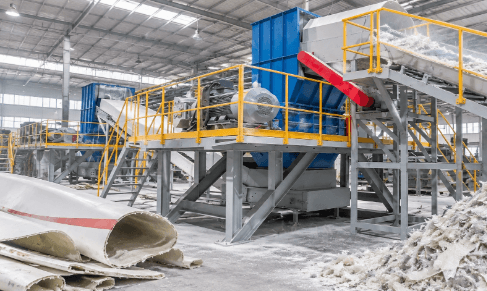
Solving Glass Fiber Dust Hazards and Rapid Blade Wear in End-of-Life Wind Rotor Recycling Plants
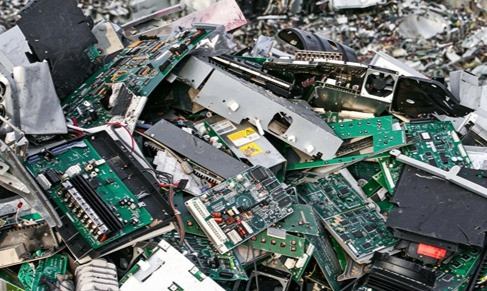
E Waste Shredder in South Africa for PCB and Electronic Waste Recycling
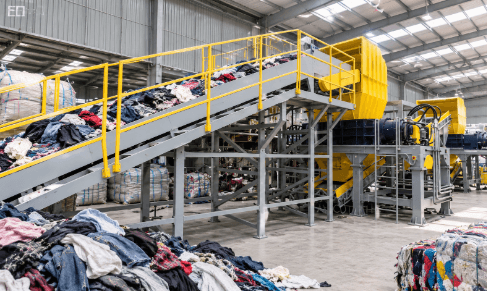
High-Capacity Textile Shredding Solutions: From Baled Garments to Clean Shoddy Fiber Opening


 中文


