
As Australia advances toward its renewable energy targets, the country’s first generation of onshore wind farms across New South Wales, Victoria, South Australia, and Western Australia is entering the decommissioning phase. Managing decommissioned industrial wind turbine blades—which can stretch anywhere from 50 to 90+ meters in length—presents a major waste management challenge for wind farm operators and environmental contractors.
With state Environment Protection Authorities (EPAs) enforcing strict landfill bans and Net-Zero circular economy targets, traditional burial is no longer a viable option. Implementing a dedicated industrial wind turbine blade disposal solution in Australia using advanced mechanical shredding is the most effective way to solve transport logistics, achieve massive volume reduction, and process tough composite waste into valuable recycled commodities.
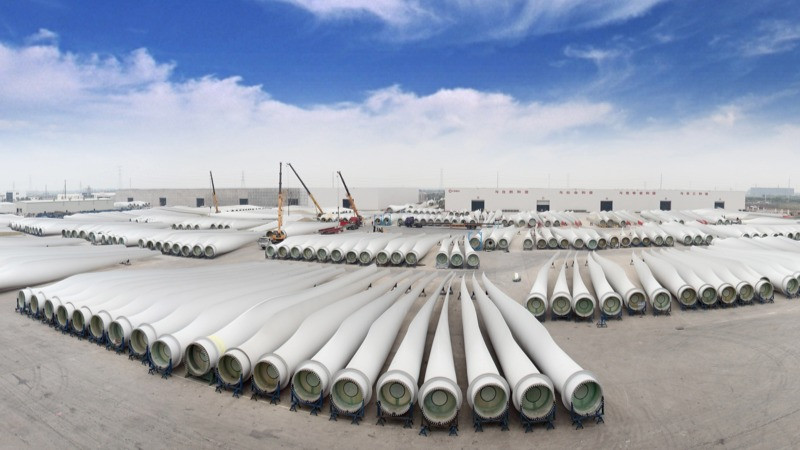
Disposing of retired composite blades in regional Australia presents unique geographical, regulatory, and mechanical obstacles:
Prohibitive Logistics and Remote Transport Costs: Australian wind farms are frequently located in remote regional or outback areas. Transporting intact, hollow, oversized turbine blades across state borders requires expensive wide-load permits, escort vehicles, and complex route planning. Paying to transport empty air drains project budgets rapidly.
Imminent EPA Landfill Bans and Compliance Pressures: Australian state EPAs are clamping down on industrial landfilling. Bulky composite blades resist compaction, take up massive landfill volume, and degrade extremely slowly, making land disposal legally and financially unsustainable.
Severe Material Resistance and Health Hazards: Wind turbine blades are manufactured from high-strength Glass Fiber Reinforced Plastics (GFRP), carbon fibers (CFRP), structural balsa wood, and tough epoxy resins. Attempting to cut or break these composite materials with standard machinery causes rapid tool wear, severe blade chipping, and airborne glass fiber dust that violates Safe Work Australia standards.
When evaluating options for recycling GFRP wind blades, mechanical physical shredding emerges as the most practical and economically viable processing path compared to chemical recycling or thermal incineration:
Lower Capital & Operational Investment (CapEx/OpEx): Chemical pyrolysis and fluidised-bed thermal recovery require immense capital investment, specialized chemical inputs, and complex gas treatment facilities. Mechanical shredding requires significantly lower capital outlay while handling massive continuous throughput.
Preservation of Material Properties: Mechanical shearing breaks composite materials down into fine fibers and resin powders without thermally degrading the glass fibers. This preserves their structural integrity, making them ideal as reinforcement fillers for secondary composite products.
Zero Hazardous Atmospheric Emissions: Unlike incineration, mechanical processing operates purely as a physical size reduction phase. It generates zero toxic atmospheric emissions or hazardous ash, streamlining local EPA licensing and environmental permitting in Australia.
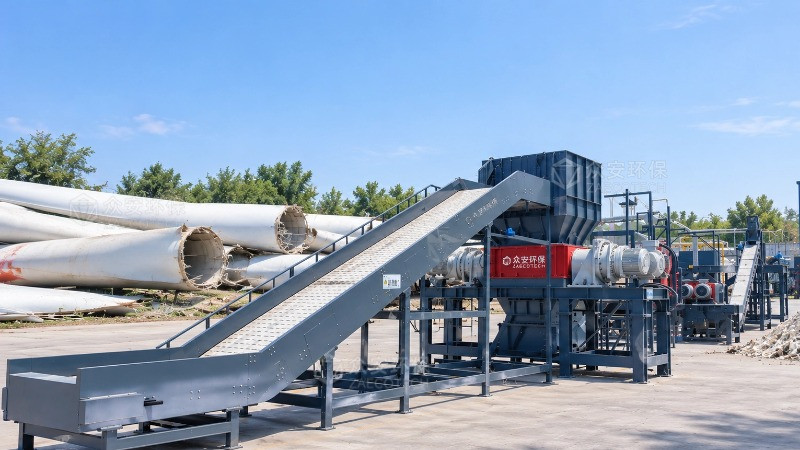
Conquering tough composite materials requires specialized heavy-duty reduction machinery. The ZA ECOTECH Wind Turbine Blade Shredder incorporates targeted engineering features built to process tough GFRP/CFRP scrap safely and continuously:
Massive Volume Reduction vs. Transport Costs: By combining hydraulic pre-shearing with dual-shaft low-speed high-torque cutting, the system achieves a 70% to 85% volume reduction. This allows operators to slash transport truck trips by 60% to 70%, enabling cost-effective long-haul logistics from regional wind farms.
Hard-Faced Alloy Cutters vs. GFRP Abrasion: Cutting blades are forged from specialized alloy steel and finished with wear-resistant surfacing layers. This extends cutter service life by 30% to 50% against highly abrasive glass fibers. Furthermore, blades can be repeatedly re-welded on-site, cutting scheduled maintenance downtime by 40%.
Intelligent PLC Protection: Integrated smart sensors monitor drive loads in real-time. If un-shreddable metal inserts or extreme resistance occurs, the PLC system automatically reverses the cutter shafts in under 10 milliseconds, preventing mechanical jams and motor burnouts.
Total Dust Control & WHS Compliance: To protect worker health and comply with Safe Work Australia regulations, the entire shredding line features enclosed negative-pressure covers paired with pulse-jet baghouse dust collectors, achieving over 99% dust capture efficiency.
ZAECOTECH provides a full range of heavy-duty wind blade shredding equipment and fine pulverizing systems tailored to diverse recycling capacities and downstream particle size requirements:
| Model | Reference Capacity | Reference Output Size |
|---|---|---|
| A6W/120 | 10–20 m³/h | 100–300 mm |
| A9W/150 | 20–35 m³/h | 100–300 mm |
| A12W/180 | 30–45 m³/h | 100–300 mm |
| A15W/180 | 45–60 m³/h | 100–300 mm |
For high-end downstream applications—such as composite fillers, high-grade plastic reinforcement, or specialized building materials—the shredding line can be seamlessly integrated with an auxiliary Ultra-Fine Pulverizing & Grinding Unit.
Depending on your target recycled product specifications, the system delivers precise particle fineness control across the following mesh grades:
Coarse & Medium Powders: 40 mesh, 80 mesh
Fine Industrial Powders: 325 mesh, 500 mesh
Ultra-Fine Composite Powders: 800 mesh, 1000 mesh, 1250 mesh
Processing bulky composite blades into fine, uniform recycled particles converts a costly waste burden into multiple revenue-generating products:
Cement Kiln Co-processing (AFR & Mineral Raw Material): Shredded GFRP fragments are ideal for cement manufacturing (Co-processing). The organic resin content provides high thermal calorific value (replacing fossil coal), while the glass fiber and silica content replace natural clay as mineral raw material in clinker production.
Infrastructure & Municipal Building Materials: Fine composite fractions serve as structural reinforcement fillers to produce high-strength recycled products, including heavy-duty composite industrial pallets, trench covers, manhole covers, and drainage gutters.
Highway Protection & Composite Profiles: Recycled fibers are re-extruded into highway antiglare shields, sound barriers, and durable wood-plastic composite (WPC) profiles for outdoor construction.
A complete processing line may include:
| Equipment | Main Function |
|---|---|
| Hydraulic blade cutting machine | Cuts oversized blades into manageable sections |
| Chain plate conveyor | Feeds blade sections into the processing system |
| Primary wind blade shredder | Reduces large composite sections |
| Secondary shredder | Further reduces material size |
| FRP grinding equipment | Produces finer composite particles or powder |
| Magnetic separator | Removes ferrous metal contaminants |
| Sorting equipment | Separates different material fractions |
| Dust collection system | Controls dust generated during processing |
| PLC control system | Coordinates equipment operation and monitoring |
The final configuration should be customized according to material characteristics, project capacity, available space, and downstream requirements.
Textile Waste to RDF Production Line: How to Turn Textile Waste into Alternative Fuel?
Solving Glass Fiber Dust Hazards and Rapid Blade Wear in End-of-Life Wind Rotor Recycling Plants
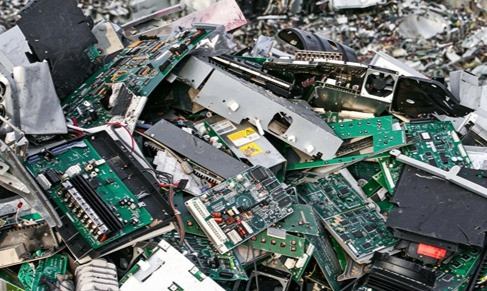
E Waste Shredder in South Africa for PCB and Electronic Waste Recycling
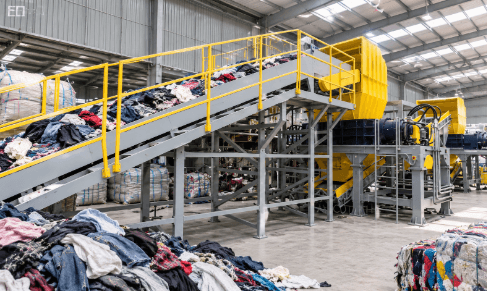
High-Capacity Textile Shredding Solutions: From Baled Garments to Clean Shoddy Fiber Opening


 中文


