
Wind turbine blade recycling Saudi Arabia is becoming an important consideration as the country's wind energy sector continues to expand. New wind projects are creating long-term demand for effective end-of-life blade management, while decommissioned blades present practical challenges for transportation, storage, and recycling.
Unlike ordinary industrial waste, wind turbine blades are mainly made of glass fiber-reinforced plastics (GFRP), resin, and other composite materials. Their large dimensions and high material strength make them difficult to handle using conventional waste processing equipment. For wind farm operators and recycling companies, an integrated recycling system can help reduce blade volume and prepare recovered materials for further utilization.

Wind turbine blades are large, bulky structures that are difficult to dismantle, transport, and process. These challenges become more significant when recycling facilities are located far from wind farms.
The main difficulties include:
Oversized dimensions: Whole blades require specialized transportation and careful route planning. Pre-cutting and size reduction are often necessary before transportation.
Tough composite materials: GFRP and carbon fiber-reinforced plastics (CFRP) combine strong fibers with resin, making them difficult to shred with ordinary equipment.
High handling and storage costs: Large blade sections occupy considerable space and require additional loading and handling.
Limited recycling pathways: Recovered composite materials need suitable downstream applications. Without an established recovery route, processed materials may still face disposal challenges.
These are not unique to Saudi Arabia. The IEA Wind Task 45 2025 Annual Report identifies technical and economic barriers, inconsistent material data, and limited end-of-life solutions as major obstacles to large-scale blade recycling worldwide. Meanwhile, a 2026 industry review cites a global blade waste projection of approximately 10,000 tonnes in 2025, potentially increasing to around 110,000 tonnes by 2030.
For Saudi Arabian projects, planning a suitable recycling process in advance can help reduce future handling pressure and improve material utilization.
A complete wind turbine blade recycling system combines pre-cutting, primary shredding, secondary size reduction, grinding, separation, and dust collection. Each stage addresses a different processing challenge.
Typical processing flow:
Pre-cutting → Primary Shredding → Secondary Fine Shredding → FRP Pulverizing → Material Separation → Dust Collection
Pre-cutting: Mobile hydraulic shears or heavy-duty diamond saws cut oversized blades into sections suitable for feeding.
Primary shredding: A high-torque multi-shaft shredder breaks down large composite sections. Reinforced, hard-faced cutters help withstand abrasive materials.
Secondary fine shredding: A fine shredder further reduces the material and provides more controlled output for downstream processing.
FRP pulverizing: A specialized pulverizer processes composite fragments into finer particles, with an adjustable fineness range of 20–150 mesh.
Material separation: A suitable sorting configuration separates recoverable fiber and other material fractions according to project requirements.
Dust collection: Dust-control equipment helps manage airborne particles generated during shredding and pulverizing.
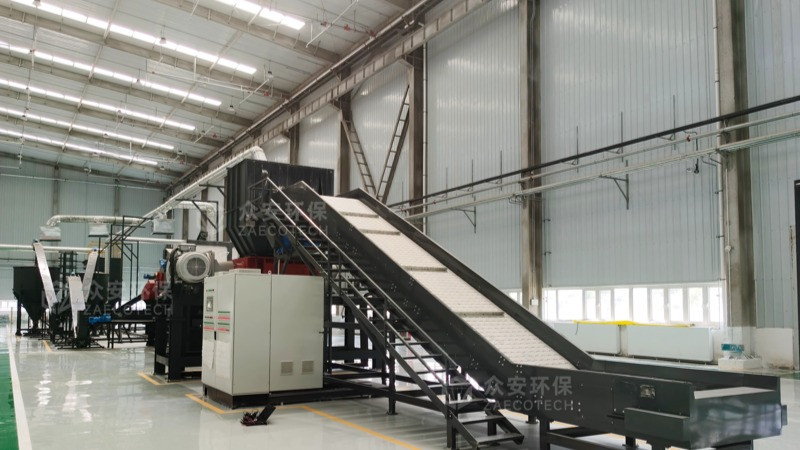
This recycling solution integrates specialized wind blade shredders, fine shredders, FRP pulverizers, and intelligent control equipment. Its system also features a high-efficiency hydraulic drive, an integral casting shredding chamber, high-alloy steel blades, and an intelligent operation and maintenance system.
The PLC control system supports load sensing and automatic reverse operation to help manage overload conditions. Equipment configuration and dust collection arrangements can be selected according to the material, processing capacity, and site requirements.
Shredding is only the first step in wind turbine blade recycling. The final utilization route depends on the recovered material's composition, particle size, quality, and the acceptance requirements of downstream users.
Common potential applications include:
Cement kiln co-processing: Suitable FRP fragments can be prepared as alternative fuel or raw material components for cement kilns, subject to the kiln operator's technical and environmental requirements.
Construction fillers: Processed FRP powder may be used in suitable filler applications when its particle size and material properties meet the required specifications.
Recycled composite materials: Recovered fibers may be considered for selected composite products, depending on fiber condition, length, and downstream processing technology.
For recycling businesses, these routes can create opportunities to reduce landfill dependence, provide waste treatment services, and develop markets for recovered materials. However, the actual commercial value depends on local demand, transportation costs, processing expenses, and the quality standards of material buyers.
The right recycling line should match the blade dimensions, material composition, required capacity, and intended output application. ZAECOTECH provides the following reference specifications for its wind turbine blade recycling system:
| Technical Parameter | Reference Specification |
|---|---|
| Processing Capacity | 5–15 t/h |
| Total Power | 160–450 kW |
| Maximum Intake Width | 1,200–2,500 mm, customizable |
| Final Output Size | 10–50 mm, adjustable |
| FRP Pulverizing Fineness | 20–1250 mesh |
| Pre-cutting Method | Mobile hydraulic shears or heavy-duty diamond saw |
| Control System | Intelligent PLC with load-sensing auto-reverse |
ZAECOTECH can customize the complete process according to these project conditions, from pre-cutting and shredding to pulverizing, separation, and dust collection. Its related project experience includes a wind turbine blade recycling project for pallet production in Hebei, with a stated capacity of 10,000 tonnes per year, and a blade shredding project in Xinjiang that entered operation in 2025.
For wind farm operators, recycling companies, and industrial waste processors in Saudi Arabia, a properly configured system can provide a practical way to manage oversized composite waste and prepare it for further resource recovery.

How to Get Rid of Wind Turbine Blades? Recycling and Disposal Solutions

How Does a Wind Turbine Blade Recycling Plant Work in the UK?
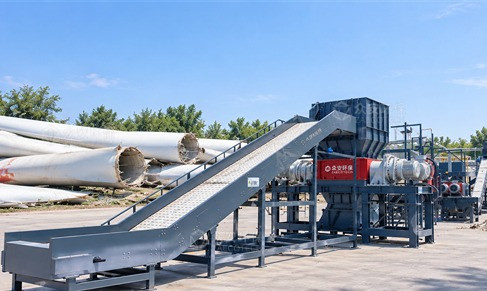
Industrial Wind Turbine Blade Disposal Australia: Best Shredding System
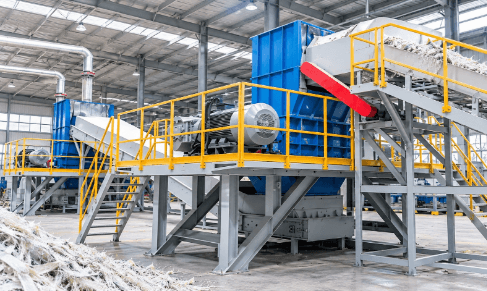
Heavy-Duty Size Reduction for Oversized Wind Turbine Rotor Blades and Carbon Fiber Composites in Spain


 中文


