
A municipal solid waste sorting system in Vietnam is becoming increasingly important as the country faces growing waste management demands and moves toward more systematic waste classification and resource recovery.
According to Vietnam's Ministry of Agriculture and Environment, the country generated approximately 69,400 tons of household solid waste per day in 2025, with an overall treatment rate of around 91%. However, collection and treatment do not necessarily mean that waste has been effectively sorted or recycled. A considerable amount of mixed waste still requires further processing before valuable materials can be recovered.
Vietnam's source-separation regulation, introduced under the 2020 Law on Environmental Protection, took effect on January 1, 2025. However, implementation remains uneven. A September 2025 report noted that only 32 of 63 cities and provinces had piloted household waste sorting at that time.
These developments create a need for waste treatment facilities that can handle mixed municipal waste and separate different material streams more efficiently.
For Vietnamese municipalities, waste management companies, and recycling operators, a mechanical sorting line can help bridge the gap between waste collection and downstream resource recovery.
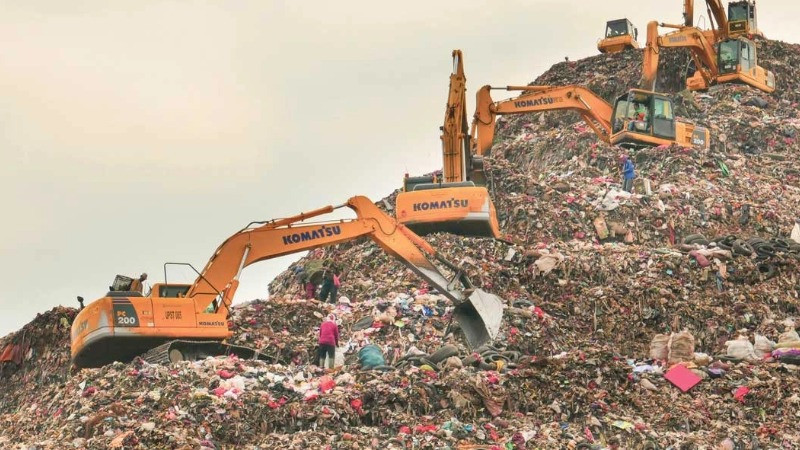
Municipal solid waste contains different materials, including food waste, plastics, paper, metals, glass, textiles, and other household residues. Their physical properties and recycling requirements vary, making mixed waste difficult to process through a single sorting method.
Mixed waste is difficult to classify
When recyclable materials and organic waste enter the same processing stream, manual sorting becomes more complicated. Wet food residues may contaminate paper and plastics, reducing the quality of recovered materials.
Labor costs and sorting efficiency are difficult to balance
Relying heavily on manual sorting requires workers to continuously identify and separate different materials. As processing volumes increase, maintaining consistent sorting efficiency becomes more challenging.
Metal contaminants can damage downstream equipment
Ferrous metal pieces mixed into municipal waste may enter subsequent shredding or processing equipment. Without effective separation, they can increase wear and cause equipment damage.
Organic waste needs a separate treatment route
Food waste and other biodegradable materials should be separated from recyclable and combustible fractions. Otherwise, contamination can affect composting, anaerobic digestion, and other biological treatment processes.
These challenges make a combination of mechanical screening, air separation, magnetic separation, and manual picking more practical than relying on a single sorting method.
A semi-automatic MSW sorting system combines mechanical separation equipment with manual quality control. Each stage handles a different separation task, helping improve the consistency of the material streams before they enter downstream recycling or treatment processes.
A typical processing arrangement can include:
Feeding and bag opening → Trommel screening → Air separation → Magnetic separation → Manual sorting → Separate material discharge
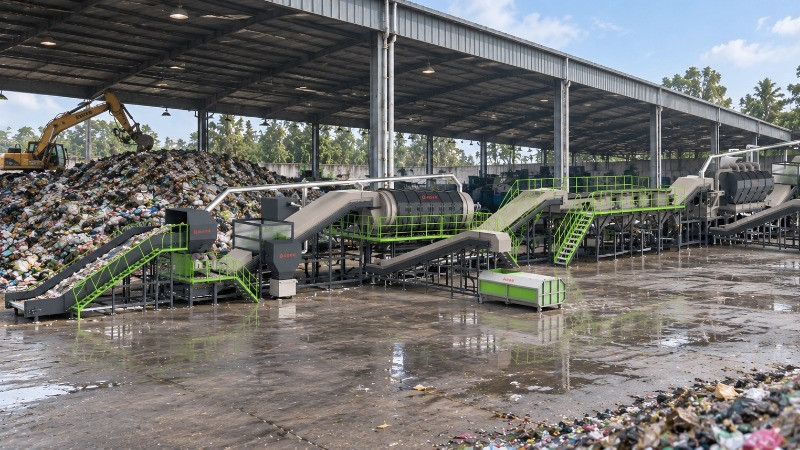
The exact sequence and equipment configuration can be adjusted according to the incoming waste composition and project requirements.
The trommel screen separates smaller particles from larger waste components through a rotating screening drum with different screen openings.
This helps separate fine organic-rich materials and other small fractions from larger recyclables and residual waste. Its enclosed structure also helps control dust during operation.
The air separator uses differences in aerodynamic behavior to divide lighter and heavier fractions.
Light materials such as plastic films and paper can be separated from heavier materials, depending on their shape, density, and moisture conditions. Adjustable airflow helps the equipment adapt to different waste compositions.
The magnetic separator uses a stable magnetic field to continuously remove ferrous contaminants from the waste stream.
ZAECOTECH's self-cleaning magnetic separator uses NdFeB permanent magnets and is designed to remove ferrous materials weighing approximately 0.1–3 kg. This helps recover iron-containing materials while protecting downstream shredders and other equipment from metal-related damage.
Mechanical equipment performs the main separation tasks, while workers on the sorting platform remove remaining non-recyclable impurities and unsuitable materials.
This final quality-control stage helps improve the purity of recovered materials and supports more stable downstream processing.
For projects requiring higher levels of automation, optional configurations may include NIR optical sorting, ballistic separation, or eddy-current metal separation. These should be selected according to the target materials, recovery requirements, and investment budget.
The right sorting line should match the amount and composition of waste generated by the project. Selecting equipment based only on daily tonnage may lead to an unsuitable configuration if moisture content, material size, and recyclable proportions are not considered.
ZAECOTECH's semi-automatic MSW sorting line provides the following published reference parameters:
| Technical Parameter | Published Specification |
|---|---|
| Processing Capacity | 100–1,000 tons/day |
| Recyclables Recovery Rate | Over 85% |
| Organic Material Purity | ≥95% |
| Required Operators | 3–8 people |
| Line Configuration | Modular and customizable |
| Control System | Distributed PLC control with SCADA monitoring |
When planning a project in Vietnam, operators should evaluate several factors:
Daily processing volume: Consider both average and peak waste intake.
Waste composition: Identify the proportions of food waste, plastics, paper, metals, and other materials.
Moisture content: High-moisture waste can affect screening and air separation performance.
Labor availability: Determine the appropriate balance between mechanical separation and manual sorting.
Site conditions: Consider available floor space, power supply, waste storage, and vehicle access.
Future expansion: Modular equipment arrangements can make it easier to increase capacity or add sorting stages later.
A properly configured semi-automatic line can reduce repetitive manual handling while retaining workers for material inspection and quality control.
The purpose of municipal waste sorting is not simply to divide waste into different categories. It is to prepare each material fraction for a suitable recycling or treatment route.
Plastic and paper recycling
Recovered plastic containers, films, cardboard, and paper can be transferred to specialized recycling facilities. Depending on material quality, further processes may include cleaning, shredding, sorting, and reprocessing.
Metal recovery
Ferrous metals separated by magnetic equipment can be collected and sent to metal recycling facilities. If non-ferrous metal recovery is required, additional equipment such as an eddy-current separator may be incorporated into the system.
Organic waste treatment
Separated food waste and other biodegradable materials can be processed through composting or anaerobic digestion. Composting produces soil-improving materials, while anaerobic digestion can generate biogas for energy applications. Organic purity and contamination levels are important for both routes.
RDF fuel preparation
Combustible residual materials, including selected plastics, textiles, and paper, may be used as feedstock for refuse-derived fuel production. However, sorting alone does not produce finished RDF. Further processing, such as shredding, screening, drying, and fuel preparation, may be required to meet the specifications of cement kilns or other industrial users.
Residual waste treatment
Materials that cannot be economically recycled or recovered should be directed to an appropriate disposal or treatment facility. Effective sorting helps reduce the amount of mixed waste requiring final disposal.
By separating different material streams before further processing, a municipal solid waste sorting system can support recycling, organic waste utilization, and energy recovery within an integrated waste management facility.
Municipal waste composition varies between cities, collection areas, and seasons. A sorting line designed for one project may not be suitable for another without adjustments to its screening, separation, and material-handling configuration.
A practical solution should be based on actual waste samples, target recovery materials, required processing capacity, and available site conditions.
ZAECOTECH provides semi-automatic MSW sorting lines with modular equipment configurations, including trommel screens, air separators, self-cleaning magnetic separators, manual sorting platforms, and supporting conveyors.
The system is designed for processing municipal solid waste, landfill waste, and organic waste, with published processing capacities ranging from 100 to 1,000 tons per day.
To determine a suitable configuration for a project in Vietnam, the following information is helpful:
Type and composition of incoming municipal waste.
Required daily processing capacity.
Moisture content and approximate input size.
Target recyclable materials and recovery requirements.
Available installation area and site conditions.
Textile Waste to RDF Production Line: How to Turn Textile Waste into Alternative Fuel?
Solving Glass Fiber Dust Hazards and Rapid Blade Wear in End-of-Life Wind Rotor Recycling Plants
E Waste Shredder in South Africa for PCB and Electronic Waste Recycling
High-Capacity Textile Shredding Solutions: From Baled Garments to Clean Shoddy Fiber Opening


 中文


